Frida Kahlo is one of the most compelling figures in twentieth-century art. Despite the devastating accident that transformed her entire life, Frida found her calling, became one of the world's foremost painters, and maintained an extraordinary strength of spirit until her final days.
In this article you will learn about:
- Frida Kahlo's childhood;
- the beginning of her artistic career;
- her turbulent relationship with Diego Rivera;
- Frida's recognition in America;
- the artist's most celebrated quotes.

Frida's Childhood
Frida Kahlo Calderón was born in the village of Coyoacán on the outskirts of Mexico City on 6 July 1907, the daughter of photographer Guillermo Kahlo and Matilde Calderón. Kahlo claimed she had been born in the famous blue house that thousands of tourists now come to photograph when visiting Mexico City, but in fact the birth took place in the neighbouring house where Frida's grandmother lived.
At the age of six, Kahlo contracted polio — a disease that typically attacks the nervous system and can lead to paralysis of the limbs or the entire body. In Frida's case, the illness affected her right leg, causing it to become thinner than the left. She spent the rest of her life concealing this condition beneath long skirts.

The illness made Frida withdraw into herself, and she became a target for her peers' mockery, yet within the family she was surrounded by care. Her father, Guillermo, trained with her in boxing to help her recover — despite the sport being considered a boy's pursuit. He also taught Frida literature and philosophy, and showed her how to take and retouch photographs.
Because of her polio, Kahlo started school later than other children. She first enrolled in a German school, but was expelled for unruly behaviour and transferred to a teacher-training college. There she encountered harassment from one of the instructors and soon left that school as well.
In 1922, when Frida was fifteen, she gained a place at one of Mexico's finest educational institutions — the National Preparatory School, known as the Preparatoria. There she studied medicine and was preparing to become a doctor. Admission was far from easy, especially since girls had only just begun to be accepted at the school; even so, Kahlo performed excellently. Of the 2,000 students admitted that year, only 35 were girls.
Kahlo felt awkward about being the oldest student in her year, so she concealed her real age, claiming she had been born in 1910 — the year the revolution began — and calling herself a "daughter of the revolution." Within the school, Kahlo and eight classmates formed an informal group called the Cachuchas, devoted to art and philosophy. The members also cultivated ideas of national identity and liberation from colonial thinking. In time, all of the Cachuchas' participants would become leading figures in Mexico's cultural elite.
The Accident and the Beginning of an Artistic Path
Frida was eighteen when she and her boyfriend Alejandro were involved in a horrific accident: the wooden bus they were riding collided with a tram. Frida sustained severe injuries — a triple fracture of the spine in the lumbar region, a broken collarbone, broken ribs, a triple fracture of the pelvis, eleven fractures in the bones of the right leg, a shattered and dislocated right foot, and a dislocated shoulder. In addition, a metal handrail was driven through her pelvis.
She spent a month in hospital and then lay bedridden for nearly a year. A career in medicine was no longer possible, so Frida began to consider becoming a medical illustrator. She asked her father for brushes and paints. A special easel was rigged to allow her to paint lying down, and a large mirror was fixed to the canopy above her bed.
Lying in bed as she recovered from the terrible accident, she began to paint her first pictures. From that point on, the themes of death and the fragility of the human body would recur throughout her work, and the hospital bed became something of an emblematic motif in her art.
Most of the works Kahlo painted during that period were portraits of her sisters, school friends and herself. Yet the very first painting she completed was a self-portrait — a choice that would permanently define the direction of her art: 'I paint myself because I spend so much time alone and I know myself better than anyone.'
After her recovery, Frida joined the Mexican Communist Party and met a number of political activists and artists, among them the exiled Cuban communist Julio Antonio Mella and the photographer Tina Modotti. It was Modotti who introduced Frida to her future husband — Diego Rivera — one of the most celebrated artists of the day.
A marriage of the dove and the elephant
Diego Rivera himself described one of his first encounters with Frida: 'I was working on one of the frescoes in the Ministry of Education building when I heard: "Diego, please come down! I want to discuss something important with you!" I turned my head and looked down. Standing on the ground below me was a girl of about eighteen. She had a beautiful, vital body, crowned by a delicate face. Her hair was long; dark, thick eyebrows met above the bridge of her nose. They resembled the wings of a blackbird, and their black arches framed two dark brown eyes.'

Frida told Rivera: 'I haven't come here for fun. I need to earn a living. I've painted a few pictures and I'd like you to look at them as a professional. I need an honest opinion, because I can't afford to simply flatter my own vanity. I want you to tell me frankly whether I have enough talent to make it worth my while. Will you look at them?'
Kahlo showed him three portraits. Rivera was impressed; in the canvases he sensed an unusual energy, a distinct character and, at the same time, a genuine seriousness. There was none of the affectation that young artists typically employ to appear original. On the contrary, Rivera saw in them honesty and a voice entirely her own. It was clear to him that Frida was a true artist. 'I didn't know it then, but Frida had already become the most important part of my life. And she remained so until her death, throughout the twenty-seven years that followed,' Diego wrote.
Despite Rivera being twenty years older than Kahlo, the two began seeing each other and made plans to marry. Frida's mother opposed the union, calling it a marriage between a dove and an elephant: Rivera was tall and heavyset, while Kahlo was slight and fragile. Her father, however, gave the marriage his blessing. He knew that Rivera was wealthy and would have no difficulty supporting a family.
After the wedding, Frida and Diego moved to the state of Morelos, which had seen some of the fiercest fighting of the civil war. The move left its mark on Kahlo's work. She drew ever more inspiration from Mexican folk art. The historian Andrea Kettenmann has also argued that she was significantly influenced by a treatise written by the Mexican artist Adolfo Best Maugard. Techniques he described in general terms can be found throughout her work: the absence of perspective and the blending of pre-Columbian and colonial elements from Mexican art.
Like many Mexican women artists, Frida began wearing pre-Hispanic dress: long, vivid skirts — the Tehuana costume — elaborate headdresses and heavy jewellery. This style allowed her to express her feminist and anti-colonial ideals; she had no wish to conform to European fashion, and she remained faithful to it even after she and Diego moved to San Francisco in 1931.
The American period
In the United States, Diego painted frescoes for the San Francisco Stock Exchange and the California School of Fine Arts. As in Mexico, he was a celebrated figure; Frida was known simply as his wife. During this time she was introduced to prominent American photographers and artists, among them Nickolas Muray, with whom she began a relationship that would last ten years.
The six months in San Francisco proved productive for Frida — she painted one of her most celebrated works, Frida and Diego Rivera. It is a double portrait. In it, Frida and Diego stand hand in hand — a symbol of their love. Rivera holds a palette and brush, reflecting Frida's enduring admiration for his talent. Unlike her other works, with their vivid colours and layered scenes, this painting contains nothing to distract the eye from its two subjects. Much to Frida's own surprise, the canvas was selected for the annual exhibition of the San Francisco Society of Women Artists — the first time her work had ever been shown to the public.

After a brief return to Mexico, Kahlo and Rivera came back to the United States in 1932, this time to Detroit. By now Frida spoke fluent English and had no reservations about talking to the press. On her very first day she declared that, of the two of them, she was the better artist.
Many aspects of life in the United States left her cold. Most Americans struck Kahlo as dull and unfeeling. In a letter to a friend, Frida wrote: "I have seen thousands of people here enduring the most terrible suffering — without food, without sleep. It is horrifying to watch the rich throwing parties night and day while thousands of people are dying of hunger." In Detroit she was also outraged to find that certain hotels refused to admit Jewish guests.
Artistically, the year went well. Kahlo began experimenting with new techniques — etching and fresco among them — and placed increasing emphasis on themes of pain, bodily fragility and human suffering. She produced several paintings in the manner of retablos (small, colourful Mexican votive pictures painted in gratitude to the saints). Among those works are two landmark pieces: Henry Ford Hospital and Self-Portrait on the Borderline Between Mexico and the United States.
The first was painted after her second miscarriage. It shows Frida lying on a hospital bed, holding above her abdomen three red ribbons that resemble arteries. The end of one ribbon becomes an umbilical cord leading to a foetus — the child lost in the miscarriage. Above the head of the bed hovers a snail, a symbol of the slow, painful course of a failed pregnancy. An anatomical model of the lower torso above the foot of the bed, like the model of a bone at the lower right, points to the cause of the miscarriage: the spine and pelvis damaged in her accident. The object at the lower left may represent her own "defective" muscles, which prevented her from carrying the child to term. The purple orchid depicted at the centre below the bed was brought to Frida in hospital by Diego.
The second painting reveals Frida's ambivalence towards the United States. Kahlo portrays herself on a pedestal as a living statue, a small Mexican flag in her hand. Her figure divides the composition into two halves. On the left is her native Mexico — its history and symbols woven into the cycles of nature. On the right is an image of the United States, a world ruled by machines, skyscrapers, industry and smoking chimneys.
Although none of the works she painted that year was shown at exhibitions in Detroit, a local newspaper ran an interview with Frida under the condescending headline: "Wife of the Master Mural Painter Dabbles in Art."
A Return Home and Frida's Recognition
Back in Mexico City in 1934, Kahlo painted My Dress Hangs There, in which she set out to depict the shallowness of American capitalism. The canvas is filled with icons of the modern industrial United States. Frida herself is usually present in her paintings, but here she cannot be. "I may be in America, but only my dress hangs there — my life is in Mexico," she said.

On their return, she and Rivera moved into a new house in the upscale neighbourhood of San Ángel. The house had been designed by a student of Le Corbusier and consisted of two sections. The first — white and red — was Rivera's, the second — painted azure — was Frida's. The two sections were connected by a small aerial footbridge. The house became an important gathering place for foreign artists and political figures.
Despite her desire to immerse herself in her work, Frida painted no pictures during this period. Her health problems returned: she underwent an appendectomy, two abortions, and the amputation of two toes due to gangrene. On top of this, her relationship with Rivera grew strained — he had begun an affair with her younger sister Cristina, which lasted around a year. As soon as Kahlo learned of it, she wanted to divorce Rivera and even moved into an apartment in the centre of Mexico City. The separation, however, was short-lived, and the couple soon reconciled.
In 1936 Frida returned to politics and joined Leon Trotsky's Fourth International. Together with Rivera, she petitioned the Mexican government to grant asylum to Trotsky, who had fled the Soviet Union. He arrived with his wife Natalia Sedova, and they settled in Frida Kahlo's Blue House. During the two years Trotsky spent in Mexico, he and Kahlo became friends and lovers. Frida even painted a self-portrait for him. Beyond this, she also produced several other significant works during the period: What the Water Gave Me, Memory (The Heart), and My Nurse and I.


Although Frida was still uncertain about her work, in early 1938 the National Autonomous University of Mexico exhibited a number of her paintings. That same year, the French writer André Breton organised a solo show for her in the United States at the Julien Levy Gallery. Despite the Great Depression gripping the country, half of the exhibited works sold. In France, where Breton had also promised to arrange an exhibition for Frida, technical difficulties arose; moreover, Marcel Duchamp's gallery agreed to take only two of her paintings, deeming the rest too shocking.
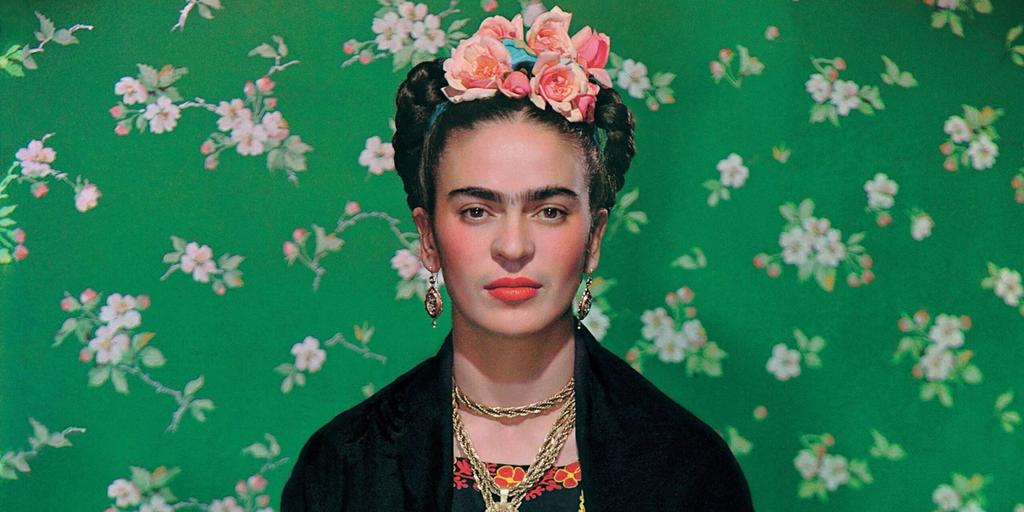
The London exhibition fell through largely due to a lack of funds and the approaching Second World War. Even so, the Louvre purchased one of Frida's works — the self-portrait The Frame — for its collection. She was also warmly received by her Parisian peers, Pablo Picasso and Joan Miró. The fashion world embraced her as a new style icon: it was at this time that Nickolas Muray took his celebrated photograph of Frida, which appeared on the cover of the Paris Vogue supplement. On returning to New York, Frida hoped to rekindle her relationship with Muray, only to learn that he was engaged to be married and felt obliged to end things with her.
Later Years
In Mexico City, too, bad news awaited her. Rivera demanded a divorce, though he publicly stated that it was 'a matter of legal convenience, with no sentimental, creative or financial reasons behind it.' Despite the divorce, they remained friends: she continued to manage his finances and correspondence.
After the divorce, the artist painted The Two Fridas. The canvas depicts two versions of herself. One is the traditional Frida in a Tehuana costume — the image Diego had loved (on the right); the other wears a Victorian-style wedding dress. Both women are unhappy: one has been left behind by love, the other condemned to a life without a heart. Both are dying, because the main artery connecting their hearts has been cut, though it is held closed by a surgical clamp. Since 1947 the painting has been held in the National Institute of Fine Arts in Mexico City.

In 1941, Frida's work was shown at the Institute of Contemporary Art in Boston, and the following year she took part in two high-profile exhibitions in New York. In 1943, her paintings were included in the exhibitions 'Mexican Art Today' at the Philadelphia Museum of Fine Arts and in the Guggenheim Gallery 'Art of This Century'. She also gained recognition in Mexico City, where she exhibited, participated in art conferences, and was appointed as a teacher at a school for artists.
In 1950 she spent nine months in hospital, undergoing seven spinal operations, after which she suffered such unbearable pain that she could no longer work without painkillers. Her painting began to be marked by weak, hurried, almost careless brushwork — a consequence of taking powerful medication. The artist's desire to introduce a political dimension into her work, to serve the Revolution, became especially pronounced in her 1954 paintings Marxism Will Give Health to the Sick, Frida and Stalin, and in an unfinished portrait of Stalin. On the morning of 13 July 1954, a nurse found Frida dead. According to her account, Kahlo had taken more pills than she should have, and died of an overdose.
Other self-portraits by the artist
Frida's Quotes
- The most amusing thing in the world is tragedy.
- I used to drink to drown my sorrows, but they learned how to swim.
- There is nothing more precious than laughter — it lifts you out of yourself, makes you weightless.
- Revolution is the harmony of form and colour; everything moves and everything stays still, obeying a single law: its name is life.
- I paint myself because I spend so much time alone and I know myself best.
- Art is the equivalent of blood in the social organism of humanity.
- There have been two great accidents in my life. One was the train, and the other was Diego. Diego was the worst.
Links
- Arts & Culture Google — a virtual museum where you can explore more of her works, photographs of the studio, and Frida Kahlo's striking wardrobe;
- Manezh — the Frida Kahlo exhibition in Moscow;
- frida-kahlo-foundation.org — an unofficial website about the artist;
- artchive.ru — information about exhibitions and an archive of her works.
Read Losko's features on other artists, for example, about Edward Hopper and his architecture of solitude.
Follow us on social media so you never miss a new story: VKontakte, Telegram — @loskomagazine.