Jackson Pollock created Abstract Expressionism — an art movement of the last century that shifted the world's attention from European classicism to American innovation. Yet at the height of his fame, the artist permanently abandoned the drip technique that had brought him worldwide renown, and presented the public with a body of ink works of which only a single piece sold, and even then at half price. A few years later he died in a car crash, having driven while drunk. A lover who was in the car with him claimed it had been a suicide. So who, exactly, was Jackson Pollock?
In this article you will learn:
- about Pollock's life: his childhood, his move to New York, and the fatal accident
- about a dizzying rise and an equally dizzying fall
- about why Pollock's paintings are worth hundreds of millions of dollars today
- about his particular understanding of art
- about his struggles with alcohol, which began in his school years
- about his wife with Russian roots, and his lovers
- about why many considered him rude and lazy

Childhood and Youth (1912–1929): The Wild West and Native Americans
The American artist Jackson Pollock was born on 28 January 1912 in Cody, Wyoming. Ranch country, cowboys and farming — that was all the town had to offer. Jackson was the youngest of five brothers. His quiet, modest father, LeRoy Pollock, was a not particularly successful farmer, and the family was constantly moving around the country in search of work. The boys were raised by their mother, Stella May Pollock — an authoritarian woman prone to anxiety.
The boys often helped their father and even spent some time working as labourers at the Grand Canyon. On these trips, Jackson encountered Native American culture, an experience that would later shape his work.

In 1928, when the family settled in Los Angeles, the sixteen-year-old enrolled at a manual arts high school but was almost immediately expelled for drinking and disorderly conduct. That same year he was expelled from another school as well.
Beginnings (1930–1937): New York, the Great Depression, and Regionalism
In 1930, persuaded by two older brothers who were already living there, Jackson moved to New York. The future artist moved into the apartment of his brother Charles and his wife Elizabeth. The country was in the grip of the Great Depression: markets had collapsed, money was desperately scarce, and many people were going hungry. Yet the Pollocks were captivated by the city and full of plans to make their mark on it.
Elizabeth recalled: "It was the time of the Great Depression. We were very poor, but absolutely happy! When I first saw Jackson, I thought he was the most attractive of all the Pollock brothers — his smile was dazzling. And although it turned out to be nothing more than a way of manipulating people, at first I was completely taken with him. Only later did I understand that Jackson was selfish, spoilt and lazy."

Jackson was indeed a difficult character: arrogant, proud and dismissive. On top of that, the young man drank heavily and smoked, which only made these traits worse. He was searching for a strong figure who could serve as an authority and point him in the right direction.
That steadying influence came in the form of the painter Thomas Hart Benton, with whom Jackson and his brother Charles studied at the Art Students League of New York. Benton worked in the styles of Regionalism and Mexican Muralism — that is, he depicted the everyday lives of Americans and the Native peoples of the Midwest in a realistic manner, striving to make his subjects as accessible and relatable as possible to the widest audience.
A number of Pollock's early paintings were executed in a similar style, yet the teacher's influence was not substantial — Jackson worked predominantly in his own direction. He did, however, absorb from Benton a sense of rhythmic composition and a drive toward artistic independence.


The sculptor Reuben Kadish, a student friend of Pollock's, recalled: "When I first saw Jackson's work, I thought it was energetic and alive — as though it was speaking directly to the viewer. We often visited exhibitions of ethnic graphic art together and went on trips to study indigenous art."
From 1935, Jackson spent a great deal of time at an experimental workshop, where he met artists who worked in a free style and sought to move away from the academicism dominant in the United States. Pollock was captivated by Surrealism — Picasso in particular — and his paintings grew bolder and more provocative.
Coming of Age (1938–1941): abstraction, alcohol and psychotherapy
Over four years, from 1938 to 1942, Jackson worked for the Federal Art Project — a large-scale government programme to support and employ people in the creative professions during the Great Depression. The authorities sought by every means to reduce unemployment and secure the financial wellbeing of a greater number of citizens. Almost all participants in the project adhered to realism, but Pollock continued to experiment and drew ever closer in his style to abstraction.
Meanwhile, Jackson was drinking more and more, losing control of himself and his life. For several years he saw a psychotherapist and underwent a course of treatment based on the ideas of the German psychologist Carl Jung. A follower and at the same time a critic of Freud, Jung recognised the dominant role of the unconscious. It seems likely that it was during this period that Pollock came to the conviction that the primary source of creative work lay not in the surrounding world but in a person's inner state.
Abstraction (1942–1945): Lee Krasner, early success and experimentation
In 1942, a young woman arrived unannounced at Jackson's studio with the words: "I know every abstract painter in New York except you!" She was Lee Krasner — an artist from a Russian-Jewish family that had emigrated from Ukraine to America. Three years later, Jackson and Lee were married.


As an artist herself, Lee understood Jackson's pull toward art better than anyone. She became a true friend and source of support for her husband, championed his work and believed in his talent. Her own career was less successful, largely because Jackson's came first: "He can give so much more to art than I can!" Even so, Lee continued to paint and experiment throughout her life.
After his relationship with Lee began, things started to look up for Jackson: largely through her efforts, in 1943 he signed a contract with the prominent art collector Peggy Guggenheim. That same year his first solo exhibition took place. For the rest of his career Jackson collaborated with Peggy, who promoted the work of Pollock and other celebrated abstractionists. Rumours circulated in New York that Guggenheim had been intimate with a great many men, including figures from bohemian circles. Many attributed a liaison with Jackson to her as well.

Jackson's works from this period follow the classical precepts of abstraction: a rejection of the depiction of real objects, a breaking down of form and perspective, and experimentation with colour.
Pollock began working on canvases of unusually large dimensions. His painting Mural measures six metres in length and nearly two in width.

Mural was created under rather unusual circumstances: Peggy Guggenheim had commissioned it from Jackson for her Manhattan townhouse. The art dealer herself was not entirely convinced of Pollock's talent, and had been persuaded by her assistant Howard Putzel and the artist Marcel Duchamp, both of whom saw potential in the emerging abstractionist. The salary was $150 a month — a considerable sum at the time. The money was needed more than ever, as Jackson and Lee were barely making ends meet, often scraping together their last pennies for rent while having nothing left for food or paint.
As it turned out, Pollock found himself unable to begin painting. According to Lee, he would stare at the blank canvas for days, and the days stretched into weeks, and the weeks into months. Guggenheim grew increasingly impatient and eventually issued an ultimatum: either Jackson finished the work by January, or he could say goodbye to his career. On the evening before the deadline, the canvas remained untouched — yet when Peggy woke the following morning, Jackson was standing at her door with the rolled-up painting in his hands. The work had been completed overnight.
This compelling story was recounted in one of the most celebrated biographies of Pollock, winner of the Pulitzer Prize: Jackson Pollock: An American Saga (Steven Naifeh and Gregory White Smith, 1989). In 2014, however, the Getty Museum and the Getty Conservation Institute in the United States debunked the claim, publishinga studyin which they demonstrated that at least several weeks had elapsed between the application of the various layers on the canvas. It remains entirely plausible, nonetheless, that the greater part of the work — its final layer — was completed within a single day.
The Move to Springs (1945–1947): A Change of Scene, Nature, Art
Immediately after their wedding, Lee and Jackson left central New York for Springs, a hamlet on the South Shore of Long Island. Borrowing money from Peggy, the newlyweds bought a modest house where they intended to devote themselves entirely to their art.

Pollock was struggling with alcoholism, and the rural surroundings clearly did him good. He set up a small studio in the barn, while Lee worked in a room inside the house. In their spare time they took long walks, cooked and received guests.
Jackson apparently pressed Lee to have a child, but she refused, reasoning that they were artists and that a third person would only get in the way. The family was also living in poverty, and she had no wish to subject a child to such hardship. Lee understood that Jackson was, above all else, a creative person for whom art would always come first. He would never be capable of providing the material and emotional stability that raising a child requires.
For the first couple of years after the move, Jackson continued along the path of abstraction, but in 1947 came the beginning of Pollock's 'drip period' — the phase that brought him success and made him world-famous.
The Drip Period (1947–1950): A Rapid Rise, Life Magazine and a Photographer
Among scholars and admirers of Pollock's work, a popular story holds that the artist stumbled upon the drip technique by accidentally spilling paint onto a canvas spread across the floor. How much truth there is in this is unknown, but the paintings from this period do genuinely look as though someone has splattered them at random. Strange as it may seem, this became a breakthrough.

The very first exhibition of paintings made using the drip technique attracted enormous public attention. America's artistic community could not decide what it was looking at: genius or charlatanism?
The turning point that made Jackson Pollock famous the world over was an article in Life magazine, published on 8 August 1949, under the question: 'Is Jackson Pollock the Greatest Living Painter in the United States?'

It seems fate decided to answer that question in the affirmative — Jackson Pollock gained fame, money and recognition. He was discussed at every fashionable gathering, his paintings sold for large sums, and everyone who had once looked down on him wanted to become his close friend. In some respects Pollock was fortunate to have been born at the right time in the right place: the rise of his career coincided with the rise of the United States as a great power after the Second World War. The country needed an artist who could bring American national art onto the world stage and rival the established masters of Europe. That artist was Jackson Pollock, and his vehicle was Abstract Expressionism.
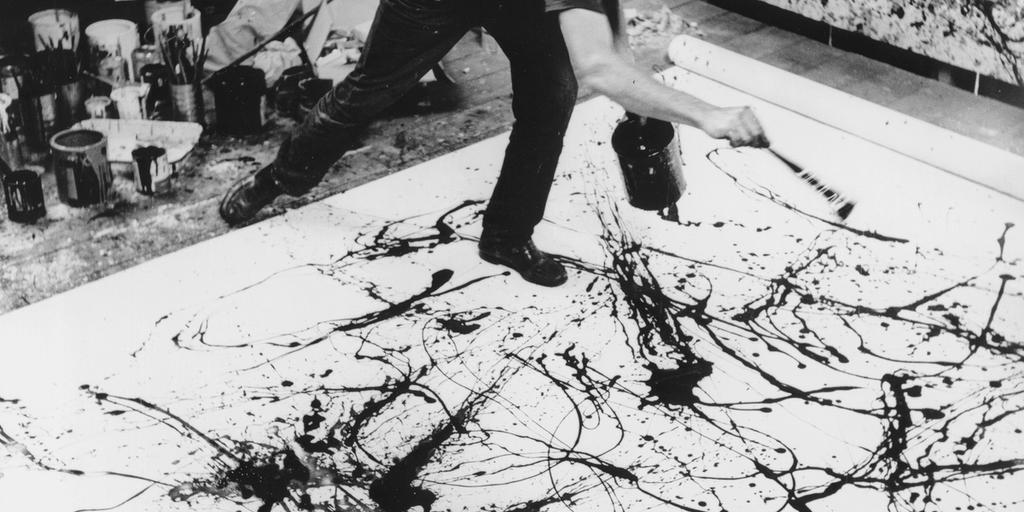
In July 1950, German photographer Hans Namuth came to the Pollocks' home to make a film about the celebrated artist. Jackson agreed, largely under Lee's influence — she understood the importance of media exposure for her husband's continued popularity. Namuth took around 500 black-and-white photographs, as well as a short documentary film that would later be studied in close detail by art scholars and critics.

The relationship between the photographer and the artist was strained, as Namuth frequently issued instructions in pursuit of a good shot. Pollock said he felt a sense of artificiality about the whole process and could not fully concentrate on his work, since he was constantly compelled to follow Namuth's directions. Tension came to a head on a cold November evening when Jackson and Hans returned home after a particularly difficult shoot. Pollock, who had given up drinking entirely after moving to Springs, poured himself a glass of bourbon. He then drank more and began to argue with the photographer. Each accused the other of being a fraud, and a drunken Jackson then overturned a table of food in front of the friends who were visiting the Pollocks that evening.
The Black-and-White Period (1951–1954): Attempts, Failure and Creative Crisis
Jackson had doubts about the drip technique and could not answer even for himself whether his work amounted to charlatanism. In 1951, at the height of his popularity, Pollock abandoned the vivid drip technique and began producing dark, inky works that reflected his inner state. It was as though he were trying to prove that his art should not be seen as superficial, effortless, decorative or merely pleasurable.

His very first exhibition in this new vein was a failure — only one work sold, and even that went for half price. Everyone asked the same question: why had Pollock abandoned the quality that made him unique and successful?
Jackson had little choice but to give up his unsuccessful black-and-white experiment and return to colour. From 1952 onwards he experimented with hues, striking a balance between abstraction and the drip technique. Yet it seems he had exhausted his inspiration. In the last five years of his life Pollock produced no paintings of any real significance. His last major work is generally considered to be Portrait and a Dream, painted in 1953.

The left side represents the dream; through the inky lines of the image one can make out suggestions of a female nude. On the right is a portrait rendered in black, with an aggressive orange-red palette introduced alongside it. Commenting on the work, Lee said that the 'dream' represented 'the dark side of the moon' — that is, the celestial body traditionally associated with feminine energy. Pollock, who had a keen interest in Freudian ideas, could hardly have been unaware of the symbol's significance.In an article in The Guardian it is argued that in this canvas Pollock addresses a question fundamental to him: what is the relationship between sex ('the dream') and genius ('the portrait')? Can a creator surrender to passion and carnal pleasure? Judging by the fact that the two symbols are placed at opposite ends of the composition, the answer is no — and might this not be read as a manifesto marking the end of his creative path? Pollock, having renounced sexual energy, ecstasy and feeling — how can he create anything at all?
Sculptor Reuben Kadish, a college friend of Jackson's, said that 'Pollock could not work under compulsion, which is why he produced so few paintings on commission and did so little work in his final years.'
Final years and death (1955–1956): wife, mistress and alcohol
A creative crisis, financial difficulties and alcohol were tearing the marriage apart: Jackson and Lee quarrelled constantly, fought and blamed each other. Lee would shout: 'Why have you stopped painting? You have to create! You cannot bury your talent in the ground!'
In early 1956 Pollock began a relationship with a young abstract painter named Ruth Kligman, who was eighteen years his junior. Lee naturally knew about the affair and threatened divorce if the meetings did not stop.
Ruth was lively, easy-going and captivated by Jackson's fame. She enjoyed parties, laughed when he drove fast, and put no brake on the heavy drinking.

That summer Lee left for Paris to stay with friends, hoping that the separation would help the relationship. She continued to love her husband and wrote him letters, hoping he would stop drinking, forget Ruth and come back to the family. Meanwhile, Ruth's friend Edith Metzger came to visit and was promptly introduced to Jackson. The man and the two women spent a great deal of time enjoying themselves.
On a warm August evening they were heading to a party at a friend's place. Jackson got behind the wheel drunk, as was his habit. He drove at reckless speed along a winding night road, which frightened Edith. She began to scream, cry and beg him to stop — Pollock only found it amusing. According to Ruth, 'he loved to drive fast because speed was how he expressed his anger.' Jackson lost control, and the car left the road three kilometres from home.
Ruth's account: 'I lost consciousness. When I came round, I realised I had been pulled away from the crash site. There was a girl nearby; I asked her to go to the car and tell me how Jack was. She came back and assured me he was alive. I asked her to swear to God. She said she couldn't. That was when I understood that Jackson Pollock was dead.'

Jackson Pollock and Edith Metzger were killed in a car crash on 11 August 1956.
Aftermath
After Jackson's sudden death, his image took on a life of its own: the slightly strange, brilliant artist who had spent his whole life wrestling with his inner demons — what better romantic hero could there be?
As Ruth Kligman observed, Pollock had nothing left in life to hold on to: he and Lee had never had children, he had exhausted himself as an artist, and close friends had turned away. Perhaps Jackson deliberately swerved off the road that night? Who can say. According to Ruth, his death was a tragic portent for Abstract Expressionism as a whole: suicide and alcohol became inseparable companions of the movement. In one interview she also claimed that 'the art market was built on Pollock's tragedy' — after his death the prices of his canvases multiplied several times over, and they continue to head the list of the most expensive works of art ever sold.

Some critics argue that such high prices suit the United States and are artificially stoked from within: every country takes pride in its artist whose paintings the whole world is prepared to pay a fortune for. What is more, Jackson Pollock's reputation might be seen as the product of a kind of cultural bubble: what would happen if art historians suddenly declared him a thoroughly ordinary painter? Books would have to be rewritten, textbooks revised, and his works moved to the attic. Why all the fuss?
Technique and style
When people first encounter Pollock's paintings, many throw up their hands and say: 'And this is worth that kind of money? I could paint that too!' They're right. There is, however, one caveat. You can press a key on a piano just as easily, and your C or B will be indistinguishable from Mozart's or Bach's. But that does not make you a great composer. What matters far more is the way Mozart or Bach combined notes to create a unified sound. The same applies to Pollock's paintings: even a child can flick paint onto a surface, but making dozens of splashes coexist harmoniously within a composition is something only Pollock could do. Therein, in all likelihood, lies his genius.

The artist's movements while dripping were not random — he painted with his whole body. Pollock honed his technique and calculated how paint would flow onto the canvas, something that was later studied extensively by art historians. On 30 October 2019, for instance, a German study was published that once again analysed the 'drip technique' from a mathematical perspective. Most notably, the authors argue that the method should not be called 'drip' painting at all, since what we see in the works are splashes and lines, not drips.
Drawing on photographs and film footage shot by Hans Namuth, the researchers derive a formula for Pollock's trajectory using three variables: the speed of the hand's movement, the distance between the brush and the canvas, and the viscosity and volume of the paint. Jackson refined his movements until the canvas received precisely the splashes he intended — which he then reproduced with a certain degree of automatism.

The study concludes that the values of these variables remain consistent across all of Jackson's canvases, generating his unique style and providing a means of distinguishing originals from forgeries. Where a forger could once simply splatter paint and produce something Pollock-like, they would now have to calculate that very formula and apply colour in accordance with it.
Particular note should be made of the sheer scale of the paintings. During his 'drip period', Jackson would lay his canvases on the floor in order to splatter paint while moving around the perimeter — sometimes even stepping onto them. The artist himself believed that art would sooner or later abandon the constraints of easel painting and move towards wall painting.

Pollock wrote: 'My painting does not come from the easel. I prefer to tack the unstretched canvas to the hard wall or floor. I need the resistance of a hard surface. On the floor I am more at ease. I feel nearer, more a part of the painting, since this way I can walk around it, work from the four sides, and literally be in the painting.'
Many critics maintain that through his boldness Jackson broke with the dominant European tradition and forged an alternative direction in art — one that drew the world's attention to the United States as a new global centre of culture. Pollock's works seem to embody America itself: a vast country where life is restless and teeming with energy.
The Phenomenon of Jackson Pollock
After the Second World War, America had become a superpower: its cinema, architecture, literature and music stood at the top of the cultural ladder. Yet the avant-garde, already flourishing in Europe and beyond, had failed to take root there. The United States therefore needed an artistic movement of its own.
It was at this moment that Jackson Pollock appeared. After the artist's death in a drink-driving accident, America continued to stoke interest in the figure of its first abstract expressionist.
Four months later, a memorial exhibition of Pollock's work was held at the Museum of Modern Art in New York. In 1967, an even larger presentation of his work took place at the same venue. In 1998 and 1999, major exhibitions were held at MoMA and at Tate in London.
From the 1980s through to the 2000s, the United States produced three documentary and two feature films about the artist.
At the same time, Pollock's paintings were setting price records on the art market:
- In 2006, at Sotheby's №5 sold for $140 million — the most expensive painting at that time.
- In 2013, the auction house Christie's offered No. 19 for $25 million; over the course of a single evening the price climbed to $58 million. It remains one of the most expensive art auction results on record.
- In 2015, No. 17A sold for two hundred million dollars and likewise ranks among the most expensive paintings ever sold.
The method — a reimagining of the work of art
The method emerged in 1947, and within just two years Pollock had been proclaimed the greatest living artist in the United States. Its foundations drew on Eastern esoteric practices, Native American culture, and psychoanalysis — the latter being the treatment Pollock pursued for his alcoholism. His work became a manifesto of freedom of expression: the very ideal on which American society's ideology was built.
His celebrated method involved dripping and spattering paint onto a canvas laid flat on the floor (Cathedral, 1947). Pollock brought a distinctive philosophy to the act of making: he was the first to answer the question of what a work of art actually is. For him, it was the time of creation — the moment of making itself.
The artist's evolution was gradual: from the influence of Expressionism and Picasso (Stenographic Figure, 1942) he moved toward Gothic (1944), where he had already shed figuration and geometry and stepped onto the path of the avant-garde. But this was not yet the manner of working that would earn him the nickname Jack the Dripper — a play on Jack the Ripper.
Around Pollock there formed the image of the modern artist: someone who had challenged the European tradition and offered a new definition of what a work of art could be. Subject matter, motifs and preconceived ideas fell away; what moved to the foreground was the artist's emotion at the very moment of creation.
Image — the engine of interest
Pollock's popularity was fuelled by his biography and difficult character: the future creator of action painting spent his childhood in poverty, was expelled from art school for truancy and drinking, and had developed a taste for alcohol by the age of nine. All of this surrounded the artist with an aura of genius and rebellion.
His sudden death in a car crash in 1956, and rumours of a possible suicide, transformed Pollock into a romantic hero. After his death, the prices of his paintings soared. In 1973, No. 11 (Blue Poles), 1952, sold for two million dollars — a record sum at the time.
Jackson Pollock arrived at exactly the right moment: he was the abstract artist America so desperately needed. He stood apart from the painters of the European tradition, making him the founder of his own artistic movement. Pollock succeeded in creating a new visual language that the cultural community came to recognise and embrace. His philosophy aligned with the ideals and mood of the United States. The public was captivated by the artist's persona, and his personality sparked debate across the cultural world. His sudden and mysterious death made him a cult figure. For two decades, films were made about Jackson Pollock. The innovator became a classic of contemporary art.
Interesting facts
- The artist's given name was Paul. Pollock disliked being called that, however, so his family and friends knew him as Jack.
- On one occasion, Pollock knocked down a wall in his house in order to create enough space for a twenty-metre canvas.
- Jackson was profoundly influenced by Picasso, and in particular by Guernica. Several of Pollock's sketchbooks survive, their pages filled with studies after Picasso's Guernica.
- Pollock did not attend his father's funeral in 1933 because he had no money for the fare home.
- Some acquaintances would deliberately buy drinks for Jackson at bars just to watch him make a scene.
- Many of Pollock's works have no title and are identified only by number. The artist did this so that people would approach his canvases with an open mind, free of preconceived ideas.
- Several films have been made about Jackson. The best known are the Oscar-nominated Pollock (2000) and Who the #$&% Is Jackson Pollock? (2006).
If your interest extends beyond abstract art, take a look at five of the most celebrated paintings made in the tradition of Surrealism.
Also follow us on social media so you never miss new content: VKontakte, Telegram — @loskomagazine.