The Dutch artist Vincent van Gogh is known the world over. But what do we actually know about him? Why did he struggle to make ends meet his entire life? What lay behind his failed attempts to obtain a formal art education? And what led to his suicide?

Early years: my youth was 'austere, cold and barren' (1853–1868)
Vincent van Gogh was born in the small village of Groot-Zundert in the south of the Netherlands on 30 March 1853. His parents chose the name Vincent for their son — a name derived from the Latin for 'victorious'. Exactly a year before his birth, the family had suffered a tragedy: their firstborn had arrived and died almost immediately, and it was in his memory that the couple named their second child. As Vincent grew older, he would often visit his dead brother's grave and sit there for long stretches, lost in thought.
His father, Theodorus van Gogh, came from what had once been a distinguished family and was a minister almost by inheritance — most of the men in his line had devoted themselves to religion. He had gentle features, was invariably polite, and was always ready to help his parishioners, who were fond of the pastor and spoke warmly of him. His mother, Anna Cornelia Carbentus, the daughter of a court bookbinder, had a volatile temperament: one moment she radiated tenderness and warmth, the next she was seized by a flash of anger. She loved to daydream and write — from time to time she would compose long, candid letters reflecting on life, and she would fill notebook pages with simple sketches of animals and plants.


In time, the minister's house filled with the laughter and chatter of children: five more were born into the family. As an adult, Vincent kept in touch with only his sister Wil and his brother Theodorus. Theo became a true friend to the artist and remained a constant presence throughout his life — for many years the brothers corresponded, and more than 600 of their letters survive.
In his contradictions, Vincent in some ways echoed his mother's character: one day he would be silent and withdrawn, the next the loudest child in the room; he loved wandering the surrounding countryside alone, yet he often organised boisterous games with his brothers and sisters; at home he could be rude and cutting, yet the villagers remembered him as a quiet, well-behaved boy. His relationship with art was equally ambivalent: sometimes Vincent would bring his mother drawings and clay figures, only to tear or smash them in fury a moment later.
Already as an adult, he wrote of himself: 'I am a man of passions, capable and prone to doing foolish things of which I am sometimes ashamed. I often say or do something too hastily, when it would have been better to wait. I think many people do the same. And if so, what can be done about it? Must one consider oneself dangerous and good for nothing? I do not think so.'

When Vincent was approaching his twelfth year, his father sent him to the boarding school in Zevenbergen, a small town some twenty kilometres from home. The boy felt lonely and abandoned, and begged his parents to take him back. Instead, a couple of years later his father transferred him to the secondary school in Tilburg. There Vincent studied painting in a modest way, but still felt no happiness, and after two years, at the age of fifteen, he returned home without explanation. Later, in a letter to Theo, he would say that his youth had been 'austere, cold and barren'.
Success in Commerce: 'What More Could I Wish For?' (1869–1875)
The family worried about the future of their eldest son: what would he become, and how would he earn a living? Three of Vincent's closest relatives — his father's brothers — worked in art dealing, the most successful being Uncle Cent, who suggested his nephew follow in his footsteps in the trade. And so, in July 1869, the sixteen-year-old began working as an art dealer at the The Hague branch of the prominent firm Goupil & Cie.
Vincent threw himself into his work with enthusiasm. He enjoyed moving in circles close to the art world, and gradually developed an ever-deeper understanding of painting and its prevailing currents. Theo also secured a position at Goupil & Cie in Brussels, which delighted Vincent enormously — their shared professional world brought the brothers even closer together.
His superiors took note of Vincent's progress and decided to promote him, transferring him to the firm's London branch. In 1873, the young man moved to England. The year proved to be one of the happiest of his life: enough money, fulfilling work, ample free time, frequent visits to museums and galleries, and a small garden of his own. Van Gogh wrote: 'I have a wonderful house, and it gives me immense pleasure to observe London life and the habits of the English themselves. I also have nature, painting and poetry at my disposal — what more could one wish for?'
It was during this period that Vincent fell in love for the first time — but, alas, the young woman was engaged to another man and rejected him. He took the disappointment hard and fell into a state of low spirits. His letters began to fill, with growing frequency, with reflections on God and religion.
Teaching, Books, Religion: 'It Is True That My Future Is Shrouded in Darkness' (1876–1879)
In May 1875, Van Gogh went to Paris on company business. His relations with his superiors deteriorated — whether on account of his emotional state, his increasingly fervent religiosity, or his criticism of management — and on 1 April 1876, Vincent resigned, leaving behind commerce for good after nearly six years devoted to it.
Hard times followed. The young man drifted from one pursuit to another: teacher of German and French at a boys' boarding school, bookseller in a small shop, assistant to a clergyman. His religious feeling grew ever more intense: he translated the Bible and gave a great deal of his time to church services. In 1877, Vincent resolved to become a pastor and to enrol at the School of Theology, travelling to Amsterdam for that purpose to stay with his uncle, a noted theologian — but he returned empty-handed after failing the entrance examination. Shortly afterwards, he became a missionary in a Belgian village, only to be asked by the church authorities to leave almost immediately.
One account holds that he was dismissed for 'undermining the dignity of the priesthood', because Van Gogh, deeply moved by the poverty of the local people, had given up his house to those in need and slept on straw in a dilapidated shack. Vincent had no choice but to return home once more, where his disappointed parents awaited him. He was weighed down by his wandering and had fallen into depression. From a letter to his brother: 'And so, for almost five years now, I have been drifting here and there without any steady work. It is true that I have lost the trust of many people. It is true that my financial situation is dire. It is true that my future is shrouded in darkness.'
At this point, Theo — whose own career in commerce was flourishing — lent Vincent his support and encouraged him to take up painting in earnest. After all, his brother had always had a passion for art, and his drawings were, by all accounts, not without merit. It seems that this was to prove his salvation.
First Steps in Painting: 'A Hand in the Fire' (1880–1883)
In October 1880, the twenty-seven-year-old Van Gogh moved to Brussels in high spirits, full of plans for the future. He wanted to sharpen his drawing skills, perhaps study under a well-known artist, and eventually earn his own living — he was still financially dependent on his parents and his brother. On Theo's recommendation he began taking lessons from the Dutch painter Anton Rappard, who in turn persuaded Vincent, always somewhat dismissive of formal training, to attend a three-month course at the Royal Academy of Fine Arts. Rappard would later become a close friend and mentor; their correspondence lasted more than four years.
The works Van Gogh produced during this period show a clear improvement in his skills: his drawings grew more complex and detailed. A serious discipline began to take shape — where he had once approached art as a pleasant pastime, he now understood the full difficulty of the craft. Vincent practised still-life compositions of the kind assigned to students at every classical art institution.


After spending some time with his parents, Van Gogh left for Etten in 1881. There he worked intensively, frequently sketching neighbours and acquaintances. He met the celebrated watercolourist Anton Mauve and was captivated by him. Mauve, for his part, pointed out the gaps in Van Gogh's technique and took him under his wing.
Around the same time, a recently widowed distant relative named Cornelia came to visit. Kee — as she was known in the family — and Vincent spent a great deal of time together, talking and going on walks. He fell in love: buoyed by his feelings, he wrote prolifically and imagined marrying her.

But it was not to be — Kee rejected Van Gogh with the words "No, never, no." The artist did not give up: he pursued her, sent letters, and tried every means to change her mind. Kee had no choice but to return to her family in Amsterdam. Even that did not deter him: Van Gogh followed her there. Her parents received him and made it unmistakably clear that marriage was out of the question. At that, Vincent held his hand over the flame of a candle and said:
Let me speak with her for as long as I can hold my hand in the fire!

Kee's father blew out the candle and threw the hapless suitor out into the street.
At the very start of 1882, a grief-stricken Van Gogh moved to The Hague. There, Mauve lent him money to set up a studio and introduced him to oil painting. Before long, teacher and pupil fell out. It is believed that Mauve had discovered that Van Gogh, out of compassion, had taken in a pregnant prostitute named Sien and her five-year-old daughter. Sien lived with Van Gogh for several years and appears in many of his drawings. The relationship was a troubled one: pressure from his family, the woman's past, children who were not his own. On top of everything, Van Gogh was still unable to earn any money from his work. The household barely scraped by. At the end of 1883, Vincent left Sien and the children.
From the Netherlands to France: "From Darkness to Light" (1884–1887)
Having ended his relationship with Sien, the artist moved again — first within the Netherlands, then on to Belgium. He continued to develop his skills by drawing the world around him. The paintings of this period are dominated by dark tones that reflect his inner state. With Theo's help, The Potato Eaters and a series of Studies of Peasant Character were put up for sale in 1885. Vincent's health left much to be desired: short of money, he ate poorly, smoked heavily and drank.


At this time Van Gogh was attending classes at the Academy of Fine Arts in Antwerp. Conflicts flared between him and his teachers, as the headstrong student refused to follow the canons. He provoked bewilderment among his fellow students as well. The Belgian painter Richard Baseleer recalled: 'An angular face, a sharp nose, a stubby pipe sticking out from a coarse, unevenly trimmed beard.' The final straw came during a lesson when, instead of the Venus de Milo, the rebel drew a full-figured peasant woman, declaring that the statue had nothing in common with a real woman.
Vincent firmly resolved to move to Paris and join his brother, convinced that only there could one learn true art — as opposed to the tedious, mechanical copying practised at the Academy. Overriding the objections of Theo, who felt his elder brother would do better to return to their parents, Vincent arrived in Paris. Inspired by the city's liberated atmosphere, he began painting in vivid colours. His work also carried hints of the Japanese style that had captivated him during his time at the Academy. Comparing the bright, colourful paintings of this period with his earlier dark canvases, it is hard to believe they came from the same hand.
In Paris the artist encountered Impressionism, then very much in vogue, and was absorbed into artistic circles. Of particular importance was his meeting with Paul Signac, who worked in the Pointillist technique, applying paint to canvas in dots. It is possible that Van Gogh developed his own technique of bold, emphatic brushstrokes under Signac's influence. Another significant friendship followed: Vincent met Paul Gauguin.
Provence, a creative commune and mental breakdown: 'The Man Without an Ear' (1888–1889)
In 1888 Van Gogh, suffering from the effects of heavy absinthe drinking and chain-smoking, moved to the Provençal town of Arles. An idea had taken hold in his mind: an artists' community! What could be more wonderful than a commune of painters? They would inspire one another and together create the greatest works of art. Vincent even began furnishing a small yellow house that was to become the heart of this creative cell. To that end he painted such works as Vase with Twelve Sunflowers, Café Terrace at Night, Starry Night over the Rhône, and The Night Café.
During this period the artist freed himself from the influence of the Parisian Impressionists and began developing a distinctive style: vivid, expressive and saturated with colour. He worked tirelessly, spending entire days and nights at the easel. This proved to be the most prolific period of his career: Vincent produced more than 200 paintings in two years.
Vincent confided to his friend Paul Gauguin: 'Even while I am working, I never stop thinking about creating a studio where you and I could be permanent residents — a refuge and a retreat for our friends at moments when they find themselves at a creative impasse.' Gauguin, who had also grown disillusioned with the atmosphere of Paris, was won over by his persuasion and arrived in Arles in the autumn of 1888.

At first, nothing seemed amiss — the friends drew together, made plans and spent long hours wandering the streets. Before long, however, quarrels broke out: Van Gogh adored his companion and longed for the same devotion in return, but Paul Gauguin, proud and arrogant by nature, saw himself as the dominant figure and had no interest in an equal partnership. Vincent seemed to sense his friend's unspoken desire to leave.
The precise details of the incident remain unknown, but after several days during which the two artists were confined to the house by torrential rain, Van Gogh came at Gauguin with a razor. Following the argument, Vincent returned to his room, where he apparently suffered a seizure in the course of which he cut off either his earlobe or the entire outer ear in a bid to atone for what he had done to his friend. He then wrapped the ear in paper and carried it to the nearest brothel, so that a girl he knew there could pass it on to Gauguin — who had, of course, already left Arles by that point.
Vincent was admitted to hospital, where he was diagnosed with acute mania with general delirium. Theo, deeply anxious, rushed to his side almost immediately. After his discharge, Van Gogh returned to his Yellow House, resumed work, and maintained that he felt entirely well. Notably, his correspondence with Gauguin also resumed: Vincent wrote to him frequently and at length, but Paul, when he replied at all, did so in a rather cool and guarded manner.
Yet the mental disturbance did not abate: the artist suffered from insomnia, hallucinations and paranoia. Episodes soon began to recur, during which he failed to recognise his attending physicians and fell into delirium. Talk turned to transferring him to another hospital. The situation was made worse by the fact that the residents of Arles had drawn up a petition in which they called Van Gogh a madman and demanded that he be confined.


In his moments of clarity, Van Gogh continued to paint. It was during this period that he developed his distinctive technique: elaborate, swirling brushstrokes.
Vincent was beginning to understand his illness and his need for specialist care: "It comforts me a little that I am starting to regard madness as an ordinary illness like any other, and to accept things as they are. During the crises, it seemed to me that everything I had imagined was real." He asked Theo to help arrange his transfer to Saint-Rémy, an asylum housed in a former monastery. Van Gogh planned to stay for a few months in order to recover, after which he intended to enlist in the army — he needed discipline and firm direction, and above all he would finally be able to stop being a financial burden on Theo.
The Saint-Rémy asylum, a creative breakthrough and suicide: "Painting is the only thing that connects the past and the present" (1889–1890)
"I cannot describe exactly what I feel. Sometimes it is attacks of anxiety for no reason, or a sense of emptiness and exhaustion in the mind" — it was in this state that Vincent arrived at the asylum in Saint-Rémy. There he encountered severely ill patients whose cries frequently echoed along the corridors of the building. A menagerie — that was the name the artist gave his new home.
Yet strangely, Van Gogh's spirits actually lifted. He saw that there were conditions far worse than his own, and understood that he both should and could overcome his illness in order to return to the world and to his work. The surrounding landscape invited painting, and his attending physician turned out to be a kind man — Vincent felt warmly towards him and even painted several portraits of him.
In time he was permitted to take walks in the grounds around the monastery. Van Gogh painted prolifically and in his own unmistakable style: the Impressionists set aside, the lessons of the academy forgotten. He was particularly drawn to cypress trees, painting them in deep, dense colours and drawing them upward across the entire canvas toward the sky.

He wrote to his mother: 'And this is the reason why in my current works one can observe harmony: painting is something in itself. Last year I read somewhere that to write a book or to create a painting is the same as raising a child… Painting is the only thing that connects the past and the present for me.'
With the arrival of autumn and cold weather, his condition worsened. Vincent pressed stubbornly on with his work and reproached himself for being a burden on Theo, who was paying for his stay in the hospital. On the eve of Christmas the artist suffered another episode, though not as severe as the first ones. In the aftermath of one such episode, Vincent, in a surge of feeling, painted The Starry Night, gazing at the landscape through his window.

Unexpectedly, a lengthy article by art critic Albert Aurier appeared in a European journal, in which he lavished praise on Van Gogh's paintings, calling them 'strange, intense, feverish creations' and extolling 'his [the artist's] profound, almost childlike sincerity'. Vincent was astonished, feeling he did not deserve such acclaim. Could it be that his work had at last been recognised and valued?
Vincent's inner world was restless. Seizures came in waves — he would rave and rage, and in the moments of calm remember nothing. The paintings Prisoners Exercising and At Eternity's Gate reflect his inner turmoil. Why does he walk in circles in the dark? Is there a way out? What lies ahead? He wrote to Theo: 'You see, I try to be good-natured, but my life is shattered, my step falters.' His mental illness had taken on a prolonged and uncontrollable character.
On 27 July 1890, Vincent set out for a walk as usual. He wandered for a long time under the scorching sun, waited for nightfall, and shot himself in the stomach with a pistol. A click. Why go on suffering? But he did not manage to kill himself. The artist lived for another two days: he smoked heavily, refused to speak to the police, and talked about life with Theo, who had come to his brother on the first available train. Vincent van Gogh, thirty-seven years old, died from loss of blood at dawn on 29 July 1890.
Series
Van Gogh loved to create entire series of works. He returned to certain subjects throughout his life.
Self-Portraits
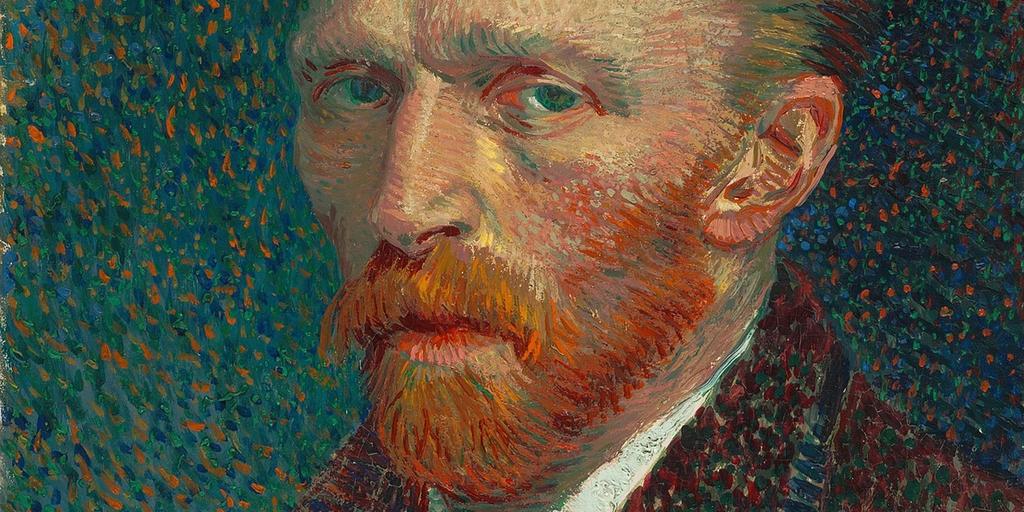
Over the course of his life, Vincent painted 43 self-portraits, each differing in palette, manner and mood. It is possible that in this way the artist was trying to better understand himself.
Sunflowers
Most of us remember the sunflowers in a vase and have heard the story of how Van Gogh painted the same bouquet several days in a row, trying to capture its gradual wilting. But few know that this is in fact only the second part of the series. Originally, the artist depicted cut flower heads lying flat.
Wheat Fields


Van Gogh painted wheat fields throughout his entire life. They became a symbol of the deep bond between humanity and nature, expressing the artist's profound respect for the everyday physical labour of peasants.
Technique
Van Gogh painted in several styles. His earliest works belong to classical realism — executed in dark tones and observing anatomical precision. After moving to Paris, he shifted to a lighter palette, seeking to capture the atmosphere of the moment in the manner of the Impressionists, whose influence he fell under. Only towards the end of his life did Vincent find his own voice: Post-Impressionism. It is precisely those expressive, eccentric canvases with their bold brushstrokes that brought him lasting fame.
Van Gogh is best known for his thick, textured brushwork — a technique called impasto (Italian: impasto, literally 'dough'). He applied paint in heavy layers, building up a sculptural surface. He would often smear the paint with his fingers rather than blending shades, using colours straight from the tube. The relief-like quality of these surfaces means that many of his paintings look quite different depending on the light.

Since Vincent barely made ends meet and for a long time depended on his brother Theo for financial support, he was forced to economise and cut back on expensive art supplies. In Arles he gave up brushes altogether, using a reed twig instead, which is why the brushstrokes in several paintings from this period appear particularly fine and sharp.

Van Gogh worked very quickly, driven by a desire to capture fleeting emotional states — which is why many of his paintings have the feel of sketches. He frequently dispensed with brushes, squeezing paint directly from the tube to create thick, dramatic strokes. In the final months of his life he painted at least one picture every day, despite his severe mental deterioration.
Van Gogh was deeply impressed by Japanese art and borrowed several of its techniques for his own painting. He would sometimes work in a single hue — the celebrated sunflowers are rendered entirely in warm yellows. He also occasionally outlined objects in dark contour lines, filling them in with flat, unmodulated colour.

Interesting facts
- Because Van Gogh had no formal academic training, errors in proportion and perspective are visible in many of his paintings.
- He devoted only ten years to painting seriously, yet produced more than two thousand works.
- Van Gogh signed his canvases with his first name rather than his surname, as he considered the latter too difficult for the French to understand and pronounce.
- An alternative account of Van Gogh's death exists: some researchers believe it was not suicide. He may have been shot during a scuffle in the village.
- His brother Theo, who supported Van Gogh throughout his life both financially and emotionally, died less than a year after Vincent's suicide. He too suffered a mental breakdown, at one point even attempting to kill his wife and child.
- Van Gogh's work became popular and commercially sought after only after his death. Several exhibitions held in his honour across Europe finally drew the art world's attention to his paintings.
- Van Gogh's works consistently top the rankings of the most expensive works of art ever sold. Portrait of Dr. Gachet, for instance, fetched $82.5 million. For most of his life, Vincent was unable to support himself.
A brief biography
- 30 March 1853: Vincent was born in the small village of Groot-Zundert in the south of the Netherlands
- 1 May 1857: his brother Theo was born, the person who would be the artist's closest companion throughout his life
- 1 October 1864: began studies at the boarding school in Zevenbergen, a small town some twenty kilometres from home
- 3 September 1866: began attending secondary school in Tilburg, where his father had transferred him
- March 1868: returned home without explanation
- 30 July 1869: took up a position at Goupil & Cie in The Hague
- May 1873: promoted and relocated to London
- 1 April 1876: resigned his post and ended his career in commerce, returning to his parents
- 1877: moved to Amsterdam to stay with his uncle, a theologian, in order to prepare for entrance to a seminary, but failed the entrance examinations
- 1879: worked as a pastor in a small Belgian village, but was forced to leave his post and return to his parents following disagreements with church authorities
- October 1880: on Theo's advice, he decided to become an artist, moved to Brussels, where he attended painting classes and met Anton Rappard, who became his mentor
- 1881: moved to Etten, where he drew diligently and met another mentor, Anton Mauve; around the same time he fell in love with a distant relative, but was rejected
- 1882–1883: lived in The Hague and was in a relationship with Sien, but ended it and moved to the Netherlands, then to Belgium
- August 1885: with Theo's help, the painting The Potato Eaters and the series Studies of Peasant Character were put up for sale
- 1886: attended painting classes in Antwerp, where he was in constant conflict with his teachers, then moved to Paris to live with Theo. In Paris he began painting in lighter tones and met the Impressionists, including Paul Gauguin
- February 1888: moved to Arles, began painting in his own distinctive style and was fired by the idea of establishing an artists' commune
- October 1888: persuaded by his friend, Gauguin came to Arles
- Late December 1888: following a quarrel with Gauguin, he cut off his ear and was admitted to a hospital
- First half of 1889: Vincent suffered from a mental disorder and moved constantly between home and hospital
- May 1889: moved to the Saint-Paul-de-Mausole asylum in Saint-Rémy
- 27 July 1890: shot himself with a pistol
- 29 July 1890: died at dawn
If you would like to learn more about other artists, you can read about David Hockney, Wassily Kandinsky or René Magritte.
Follow us on social media so you never miss new content: VKontakte, Telegram. And if you value your own time and the work of others, you are always welcome to support us financially on Boosty.