El Lissitzky was an architect, artist and designer, but considered himself first and foremost an inventor. He set out to construct a new world and to devise new laws of art for it. Lissitzky's experiments profoundly influenced architecture and design as we know them today.
In this article you will learn:
- How Lissitzky invented a new Jewish art;
- Why he fell out with Malevich;
- What the first installation in twentieth-century art looked like;
- What Rodchenko, Rem Koolhaas and Bauhaus students borrowed from Lissitzky's work.

Childhood in Smolensk, youth in Germany
Lazar Markovich Lissitzky was born in 1890 in Smolensk Governorate. His father ran a crockery shop in Vitebsk and also had a command of European languages, translating Heine and Shakespeare. In 1909 Lissitzky attempted to enrol at the St Petersburg Academy of Arts, but under the laws of the time the proportion of Jewish students at any institution could not exceed three per cent, and he was not admitted.
The artist then left for Germany, to Darmstadt, to study at the faculty of architecture at the Technische Hochschule. The city was one of the most significant artistic centres of German modernism. It was home to the Darmstadt Artists' Colony, where the great architects Henry van de Velde and Joseph Maria Olbrich worked.
Reinventing Jewish art
Lissitzky's Jewish heritage was of deep importance to him. In 1911, for instance, he travelled to the German city of Worms to see its thirteenth-century synagogue — one of the oldest in Europe. After completing his studies, the artist set out on a journey through the Belarusian Dnieper region and Lithuania, where he studied monuments of Jewish art and made sketches of gravestones in medieval Jewish cemeteries.
In 1914 the First World War broke out and Lissitzky returned to Russia. He was twenty-four. Back in Moscow, he worked as an assistant to the celebrated architect Roman Klein, and took part in the design of the Egyptian Hall at the Pushkin Museum, which Klein had built.
After the Revolution, Jewish art became the most important focus of Lissitzky's work. He joined organisations that sought to modernise the Eastern European Jewish community — to transform it from a religious group into a modern nation. A modern people needed a modern art, and Lissitzky and other young artists set about creating it.
As early as 1915, the rules restricting the publication of books in Yiddish in Russia had been lifted. It was then that El Lissitzky developed a genre new to Jewish graphic art: book illustration.
In the spring of 1917 the Jewish aesthetics society Shamir published the first book in Yiddish with illustrations by Lissitzky — Sikhes Khulin (Idle Talk), also known as The Prague Legend of Moishe Broderzon. The work represents the first attempt to create a new Jewish book. Previously, Jewish tradition had regarded secular literature as a lesser genre. The Prague Legend, however, was published in the form of a medieval scroll — a format previously reserved for sacred texts alone. In this way Lissitzky sought to elevate secular literature into a new cultural value.


Suprematist experiments
In May 1919 Marc Chagall invited Lissitzky to teach at the Vitebsk People's Art School, which he had founded. Chagall had been the artist's mentor during the period when Lissitzky was working within the Jewish tradition. At the VPAS, the twenty-nine-year-old El Lissitzky taught architecture and printmaking. Before long, however, under Malevich's influence he abandoned Chagall's principles and turned to Suprematism. "I had a student who swore loyalty and devotion to me, who regarded me as something close to a messiah. But once he became a teacher himself, he went over to my enemies and, as best he could, denounced and drove me out," Chagall recalled with bitterness.

"Malevich was not to blame — all the students went over to him of their own accord. And what could Chagall teach them? He was no teacher at all. They imitated his flying Jews. Even Lissitzky was under Chagall's influence at first. But Malevich recognised his worth immediately. He drew out Lissitzky's architectural foundation and suggested he take up volumetric Suprematism," recalled the poet Nikolai Khardzhiev, who was a close friend of Malevich.
That same year, El Lissitzky created his most celebrated work: the Prouns — "projects for the affirmation of the new." These were abstract geometric compositions that could exist in both two-dimensional and three-dimensional form. The Prouns emerged through Malevich. Lissitzky studied Suprematism under him, and together they worked at VKhUTEMAS, where they founded the artistic collective UNOVIS — "Champions of the New Art." Malevich gave Lissitzky the task of translating Suprematism into volumetric forms, which were ultimately to become the architecture of the future. The first Proun was given an architectural title: "House over the Earth."
The Prouns were conceived as a universal system. Lissitzky believed they would become the principal building block of a new, communist world. He was sceptical of artistic experiments that served no practical purpose, and said: "What are 'formal investigations'? Art does not search. When it has lost its way, there is no art at all." For this reason the artist employed Prouns not only in painting and graphic work but also in architectural and design projects, typography and furniture.

Gradually the Prouns ceased to resemble architectural drawings — circles, sharp angles and stars began to appear within them. Over time they evolved into fantastical compositions. Eventually Malevich himself acknowledged that the Prouns had grown from a Suprematist experiment into an independent phenomenon. This became the source of friction between the two artists, and in 1921 El Lissitzky left Vitebsk for Germany. In response, Malevich called him "a fox." Lissitzky, for his part, was not offended. He wrote to Malevich: "The reproaches you level at me do not anger me. On the contrary, I prefer to speak from the heart, even when it is not always pleasant. In Europe one loses the habit of that." The friendship endured, and Lissitzky went on to champion Malevich's art in the West.

Why El?
Lissitzky began signing his work "El," or "El," in 1919. The artist constructed the pseudonym from the initial letters of his first name and surname in Yiddish — "Eliezer Lissitzky." It was used not as a given name but as a prefix to the surname: his contemporaries wrote the pseudonym with a hyphen, "El-Lissitzky."
Lissitzky and the Bauhaus
In 1921, when Lissitzky was 31, he was appointed cultural envoy of the Soviet Union to Germany. For five years, from 1921 to 1926, the artist lived and worked in the West. He became a vital link between Soviet and German figures in the arts. In Lissitzky's notebooks, the telephone numbers of Mayakovsky and Malevich sat alongside those ofMies van der Rohe and Walter Gropius.
Lissitzky did not take to Berlin. He wrote of the city: "Here there is neither space nor time. Souls wander. The ghosts are very pale, and there is ginger everywhere." And yet it was there that he met and befriended the leading figures of the European avant-garde.


Lissitzky's work influenced theBauhaus school, which is widely regarded as the starting point of modern design. His art also inspired Piet Mondrian, with whom he worked in the Dutch abstract artists' association De Stijl. Members of that group were among the founders of geometric abstraction in painting and Functionalism in architecture. Lissitzky was invited to join De Stijl by another great artist, Theo van Doesburg. The group also included the architect Gerrit Rietveld, who would later build the celebratedSchröder House in Utrecht — a building that resembles an enormous Proun.
The Birth of the Modern Poster
Lissitzky invented the visual language of Constructivist graphic design, which had a profound influence on modern graphic design as a whole. He abandoned elaborate hand-drawn ornament, giving his books a deliberately simplified and geometric style. The transitional work between Suprematist and Constructivist typography was the 1922 publication "Suprematist Tale of Two Squares."
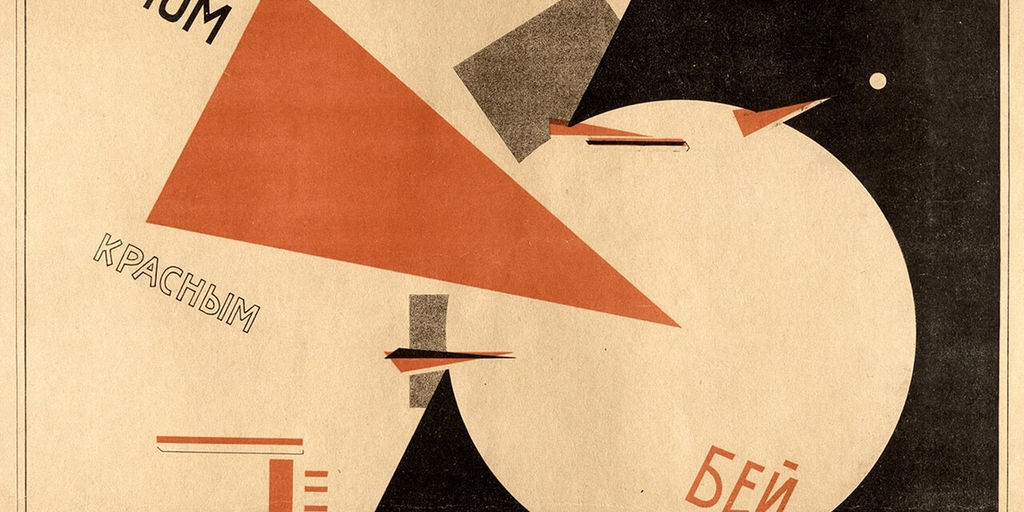
Lissitzky applied the same principles to his posters — most famously in Beat the Whites with the Red Wedge. Its composition was borrowed in 1924 by Alexander Rodchenko for his Lengiz poster, which became a classic of the avant-garde. Constructivist techniques in print design are still in use today; it was Lissitzky's work, above all, that established the tradition of modern design built on geometric abstract forms.


The first interface
In 1923 Lissitzky designed the layout of Mayakovsky's poetry collection For the Voice. The book became a benchmark of print design. Along the right-hand edge of the pages the artist cut away tabs bearing the titles of the poems, allowing the reader to locate any piece at a glance. This pictographic index is regarded as one of the forerunners of the modern computer interface.
Lenin's Tribune and the horizontal skyscrapers
Lissitzky might fairly be called a paper architect: only three of his architectural projects are known to have been built. Until 1924 he devoted almost no time to architecture, preferring painting, graphic art and book design.
One of Lissitzky's earliest architectural works is Lenin's Tribune of 1924. It derives from a sketch made in 1920 by Ilya Chashnik in Lissitzky's studio in Vitebsk. The project was originally titled Tribune for a Public Speaker for Public Squares, but while reworking Chashnik's sketch Lissitzky pasted in a figure of Lenin in the speaker's place — and the current name was born. The prouns served as the conceptual source for the project.
The tribune incorporates a mechanism that raises the speaker and unfurls propaganda elements above him. Its upper surface serves as a slogan board by day and becomes a cinema screen by night. The project made Lissitzky famous as an architect at the age of thirty-four.


In 1924 Lissitzky devised a scheme of horizontal skyscrapers for Moscow — their form, again, rooted in the prouns. The project called for eight identical skyscrapers to be erected at eight squares along the Boulevard Ring, spanning the city's main traffic arteries.
He believed the city needed a new architecture: 'They are planning a Moscow City on Nikolskaya, Varvarka and Ilyinka, in keeping with the London appetite of world capitalism. On the outskirts they are building "cosy settlements" for workers, and so on. Where do such absurd utopias come from? — From the archives,' Lissitzky declared.

He wanted to transform public squares with horizontal skyscrapers into the city's central nodes, housing the ministries of the USSR within them. The skyscrapers took the form of elongated two- or three-storey blocks raised above the ground on three vertical supports. One of these supports connected directly to a metro station, while the other two were intended to serve as tram stops. Lissitzky himself called the horizontal skyscrapers "sky irons." The influence of this project can be traced in the work of many Western architects — for example, Rem Koolhaas.
Another building by Lissitzky is the printing house of the newspaper Ogonyok, located at 1st Samotechny Lane in Moscow. The structure came about through the initiative of Ogonyok's editor, the celebrated journalist Mikhail Koltsov, who, like Lissitzky, had spent time working in Germany and was on friendly terms with him. The building's layout bears a clear resemblance to the horizontal skyscrapers. Lissitzky's authorship was not established until the 2000s.

From 1929 to 1932, Lissitzky served as chief architect of Gorky Park and designed its administrative building. The administration block was converted from a pre-revolutionary factory complex. After Lissitzky left the post of chief architect in 1932, the design underwent some changes, but it remained grounded in his work. Part of the building was later turned into the Velikan cinema — one of the first sound cinemas in Moscow. It was Lissitzky who had originally designed the space to accommodate a 975-seat cinema. During the Second World War, the building was struck by a bomb, partially destroying it. The structure still stands in a semi-ruined state: the left and right sections remain in use, while the centre is occupied by a crater.
The administration building in the 1930s
The Soviet school of design
Modern interior design owes a great debt to Lissitzky. On returning to Russia, he hoped to lead the architecture faculty at VKhUTEMAS — the Higher Art and Technical Studios. This revolutionary institution was home to the leading masters of the avant-garde. The architecture faculty was already taken, however, and Lissitzky was offered the position of head of the woodworking faculty, a post he held from 1925 to 1930.
Lissitzky took charge of the department of furniture design and interior fittings, transforming what had been a relatively low-prestige woodworking faculty into the Soviet Union's first school of design. In 1930, he presented a design for a Soviet apartment at an international exhibition. The project's key innovation was transformable furniture that allowed the function of a room to be changed with ease — a highly practical solution for the modest floor plans of Soviet housing.
A folding chair patented by Lissitzky
Exhibition architecture
At the age of thirty-three, Lissitzky invented exhibition design and became the creator of one of the first installations in twentieth-century art. He produced this installation in July 1923 for the Great Berlin Art Exhibition. It was called Prounenraum — translatable as either "Proun Room" or "Proun Space." In a cubic interior, Lissitzky mounted three-dimensional plywood models of Prouns on the walls and ceiling.

In 1926, at the International Exhibition of Painting and Sculpture in Dresden, El Lissitzky created a "demonstration space" for Constructivist art. The room allocated to him was small, so the architect devised an ingenious solution. He placed the works in specially designed niches, allowing the space to accommodate one and a half times more pieces than the other rooms. The colour of the walls shifted depending on the vantage point from which the viewer looked at them. Visitors could also open and close the works they wished to see. In this way, Lissitzky achieved a form of interactivity.
In 1927–1928, Alexander Dorner, director of the Hanover museum, invited Lissitzky to design a room for the collection of new art. He created the Cabinet of Abstractions. Two display tables were placed by the windows. For sculpture, Lissitzky designated a mirrored corner so that works could be viewed from every angle. Paintings were given niches fitted with louvers inside the display cases.

Walter Gropius wrote of this work: 'As early as 1927, Dr Dorner, together with the brilliant designer El Lissitzky, created an architecturally perfect space within his museum: the Cabinet of Abstractions. This extraordinary work, of such great significance for the art of our time, was irretrievably destroyed by the Nazis.'

Between 1935 and 1939, Lissitzky worked on the design of the All-Union Agricultural Exhibition, producing several projects for pavilions and advertising structures. A tower he designed has survived to the present day. It served as an advertising installation for Glavkonserv and directed visitors towards the Fish Farming and Pond Farming pavilions. Originally, sculptural compositions in the form of carp and a diving suit stood at the top of the tower, but in the 1950s the carp were replaced by a sturgeon. Today, only the openwork metal framework of the structure remains at VDNKh.
Propaganda montage
During the 1920s, experimental photography became popular among avant-garde artists. Lissitzky's works in this genre had a profound influence on graphic design and print as we know them today. He devised the method of the photogram — or 'photographic writing', as he himself called it. In photograms, objects are exposed directly onto light-sensitive paper.
In 1924, El Lissitzky created his celebrated self-portrait The Constructor, featuring a compass. The image of the hand points to the manual nature of artistic labour, restoring to the artist the status of the worker — so highly esteemed in the Soviet Union. Lissitzky believed that a compass was indispensable to the modern artist-inventor. In The Constructor, he employed photomontage, combining prints from two negatives.

Architectural photographer Yuri Palmin commented on the artist's work in this genre as follows: 'By creating multilayered photocollages, Lissitzky manipulated the consciousness of viewers for whom photography still stood as a sign of truth. This is precisely why his works resonate so strongly with the aims of state propaganda — photography has always been bound up with the discourse of power.'
In the years of totalitarianism, the artist had little choice but to work on propaganda materials. These included the journal USSR in Construction and the album USSR Builds Socialism, both published in several languages and aimed at foreign audiences. A confluence of circumstances meant that Lissitzky's photographic experiments became, among other things, a resource for propaganda.
In 1941, El Lissitzky died of tuberculosis. He was 51. His final works were wartime propaganda posters. The artist's friend Ilya Ehrenburg — author of the novel The Thaw — would write: 'It seemed as though everyone was bound to perish by bomb or shell, and that a natural death was unnatural. And then, at the end of December, the artist Lissitzky died.'
The artist left behind a family: in 1927 he had married Sophie Küppers, an art historian and gallery owner from Hanover. She collected paintings and purchased works byKandinsky, Mondrian, Léger, and many others. Sophie parted with her collection in order to enter the USSR and marry Lissitzky. After moving to Russia, she helped the artist with the design of the magazine USSR in Construction.

Lissitzky and Küppers had a son, Jen. During the war, in 1944, Sophie and Jen were exiled to Novosibirsk. Küppers had two sons from a previous marriage. The elder, Kurt, fled the USSR to Germany, where he was arrested as a representative of the Communists and the stepson of a Jew. The younger, Hans, perished in Soviet labour camps in the Urals, where he had been sent into exile for being German.
In 1967, at Akademgorodok in Novosibirsk, Sophie managed to organise the first exhibition of Lissitzky's work in the Soviet Union. She also wrote the first scholarly book about the artist and donated more than 300 of his works to the Tretyakov Gallery.
Follow us on social media so you never miss new content: VKontakte, Telegram — @loskomagazine.