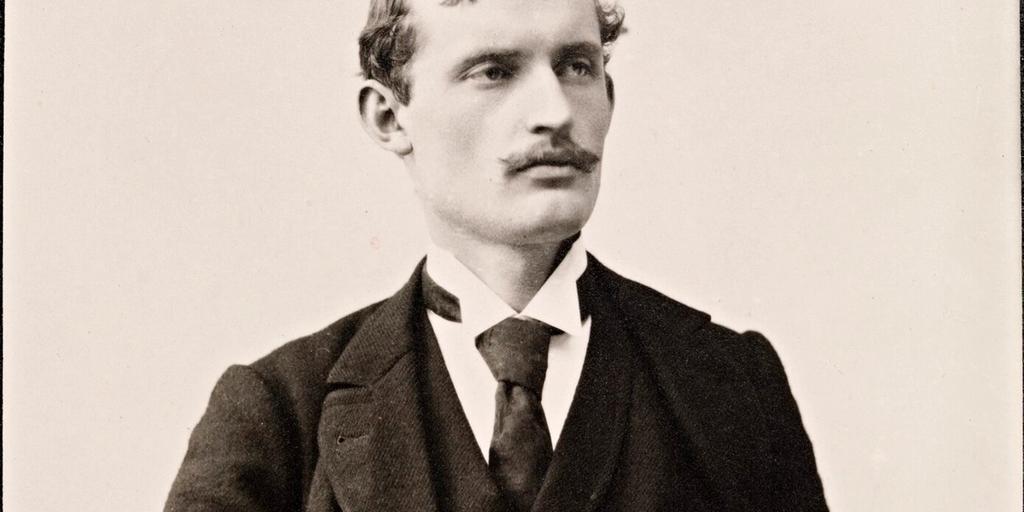
Edvard Munch was one of the founding figures of a new movement in modern painting — Expressionism. One of the most striking European artists of his era, celebrated and acclaimed in his own lifetime, he was never able to find the inner peace he so desperately sought. Painting offered only a fleeting reprieve from his own thoughts.
In this article you will discover:
- about Munch's life and how his childhood memories shaped everything that followed;
- about the clash between conservative tradition and a new manner of painting;
- what Munch expressed through his canvases;
- why he was so popular even during his lifetime;
- on the artist's mental disorders and their causes.

Childhood and Youth
The Norwegian artist Edvard Munch was born on 12 December 1863 into a modest but culturally prominent family: among their distant relatives was Jacob Munch, a noted Neoclassical painter and pupil of the French artist Jacques-Louis David.


Because his father served as a military doctor, the boy's childhood was spent moving from place to place. The future Expressionist passed most of his formative years in Christiania (Oslo), the capital of Norway.
From an early age, the child was haunted by death, melancholy and a sense of doom. When he was five, his mother died of tuberculosis. His father, Christian Munch, retreated into a religiosity bordering on fanaticism — one that verged on psychoneurosis. The impressionable boy was tormented at night by nightmares brought on by the patriarch's vivid sermons describing hell. To escape the obsessive images, he began to draw:
"I came home and wanted to make peace with my father. He had already gone to bed. I quietly opened the door to his room. He was on his knees before the bed, praying. I had never seen him like that. I closed the door and went to my own room. A restlessness came over me; I could not sleep.
In the end I took my sketchbook and began to draw. I drew my father on his knees before the bed. The candle on the bedside table cast a yellow light over his nightshirt. I took my box of paints and painted it all in colour. At last I succeeded. I lay down calmly and fell asleep quickly."
When Edvard was fifteen, his elder sister Sophie — with whom he shared a very warm and close bond — also died of tuberculosis. Her death shook him deeply. Many biographers connect this event with the artist's disillusionment with religion: the boy could not understand why, despite his father's prayers, higher powers had not saved Sophie.
After Sophie's death, the younger sister Laura was diagnosed with schizophrenia by doctors. She died in a psychiatric institution.
"From our mother we inherited weak lungs, and from our father — weak nerves," Munch later remarked.
Artistic Career
In 1879, at his father's insistence, Edvard enrolled at a technical college, where he excelled in the sciences. A year later, his passion for painting won out: the young man decided to become an artist and entered the Royal School of Drawing in Christiania. The elder Munch considered this pursuit unseemly. His aunt Karen took the boy's side, as she had always encouraged his inclination towards the visual arts.
Edvard's mentor was the Naturalist painter Christian Krohg. He was an acquaintance of Frits Thaulow — a distant relative of the Munch family and a well-known painter who had supported the young man during his disputes with his father. Krohg introduced the youth to the circle of the capital's creative intelligentsia and brought him into contact with the anarchist writer Hans Jæger. By Edvard Munch's own admission, this man had a significant influence on his work. The writer regarded Christianity as an anachronism that brought nothing but misery. Religiosity and its commandments, he believed, made people cold and cruel. Sexual desire, by contrast, was warmth and the highest pleasure — a salvation from loneliness. A person's virtue lay in their sincerity.
The artist's bohemian ways — his friendships with young nihilists, his fondness for alcohol, his nights out at restaurants — irritated Munch's father and further strained an already difficult relationship.


The painter's first work was Study of a Head, completed in 1883 in the Palace Park in Oslo. At the Autumn Exhibition that same year, the young man showed Girl Kindling a Stove, painted in a Realist manner. The paintings drew little particular attention, yet it was with them that Munch's development as an artist began. With the support of Frits Thaulow, at the end of 1884 the artist was awarded a grant and was able to visit the Paris Salon.
Criticism
At the Autumn Art Exhibition of 1886, Munch presented the painting The Sick Child. In this work, the artist rendered the anguished image of his dying sister Sophie. A young girl with a drawn, pale face rests against a raised pillow. Beside her sits a woman with her head bowed — the artist's aunt Karen. She merges into the dark background of the painting, which symbolises the grief pervading the entire household. The girl's figure stands out in the half-darkness, as if she herself were a source of light.

The model was eleven-year-old Betty Nielsen. She had come to Edward's father for help after her brother broke his leg. Her beautiful, distressed face and eyes red from crying so struck Edward that he asked the girl to sit for him. Munch painted the canvas under the influence of Jæger's philosophy and his call to 'write your own life'. For the artist, this canvas was deeply personal. In it, the young man gave form to his memories of the illness and death of his beloved sister: 'Again and again I tried to capture that first impression — the translucent, pale skin against the white background, the trembling lips, the trembling hands.'
Critics were outraged by the work of the twenty-three-year-old. The painting was called a 'miscarriage', a 'daubed' sketch, and Munch was accused of lacking technique and of unwillingness to develop:
'For Munch's own sake, I would like his painting The Sick Child to be removed from the exhibition. Not because it gives less evidence of his talent than his previous works, but because it shows his laziness in the area of self-development. The Sick Child as it now stands is a spoiled, half-erased sketch. It is a failure';
'This is no longer a matter of character, but of half-mad ravings, of the mood that arises in delirium tremens, of feverish hallucinations.'
After the torrent of criticism, the artist withdrew and turned to more conservative directions. He produced portraits and landscapes in the Impressionist style — among them a series of 'death-room' works and the 1889 painting Spring, whose subject traces not only childhood memories of his sister's final days but also the painter's own experience: that year, the artist was gravely ill.

The canvas combines two tendencies. The abundance of interior detail brings it close to Realism, while the looseness of the brushwork aligns it with Impressionism. As in The Sick Child, colour divides the composition into two parts. Dark tones, embodying illness and death, gradually give way to light ones. This gradation of colour enacts a passage from suffering towards a white oblivion.
The death of his father. Depression. A reassessment of his art.
In the autumn of that same year, Munch travelled to Paris, where he attended classes given by the French painter Léon Bonnat. His mentor held the young man's talent in high regard, but did not share his freedom with the colour palette. Edward also experimented energetically with styles. The paintings of this period show the influence of Impressionism and Pointillism — the stylistic current of Neo-Impressionism. Both styles are grounded in a technique of geometric, separate brushstrokes and a rejection of mixing colours on the canvas in order to achieve an optical effect.
In Paris, the artist devoted his free time not only to museums, excursions and the study of classical art, but also to drinking:
'I remember nothing of Paris. I only remember that before breakfast we drank to sober up, and then drank to get drunk.'
At the end of 1889, news arrived of Christian Munch's death. The event proved a heavy blow for the artist. Because of a delay in the letter's delivery, Edward did not reach his father's funeral in time. He fell into depression, stopped attending Bonnat's classes, retreated into himself and grew distant from his friends.

The artist dedicated Night in Saint-Cloud, one of the most striking paintings of his Paris period, to his late father. The room is bathed in moonlight, yet in the depths, by the window, the figure of a man can be made out. In this image, art historians see both Christian Munch awaiting death and the painter himself.
In May 1890, Edvard returned home to Christiania, where an exhibition of his work was held. Critical reception was mixed, though noticeably warmer than before. At the end of the year he went back to France once more.
In April 1892, Munch visited the Salon des Refusés in Paris, where Gauguin and Van Gogh were exhibiting — artists he would later come to admire deeply. By this point Munch was already following a firmly individual creative path. His 'Expressionist' style had taken on its defining characteristics: simplified forms, symbolic subjects, dramatic lines, and a commanding attention to colour.
The Frieze of Life. The Berlin period.
In 1892, Edvard Munch showed his work in his home city of Oslo. The exhibition left a deep impression on the conservative landscape painter Adelsten Normann, who arranged for the Expressionist's paintings to be shown in Berlin. A scandal erupted: the conservative Association of Artists demanded the event be cancelled 'out of respect for art and honest labour.' Younger artists of more progressive views disagreed with their elders, and the resulting conflict led to a split within the Association — a group of painters and sculptors who rejected the prevailing academic tradition broke away to found the Berlin Secession.
The artist, long accustomed to the barbed remarks of critics, met the situation with undisguised irony:
'You have become famous through scandal,' one of the painter's friends remarked as they sat in a tavern one evening. 'Is it really news to you that a great artist causes scandal?' Munch replied.
The episode was hotly debated in the press and lifted Munch another rung higher in his fame, making him the subject of wide discussion. At this point his art still won few admirers, yet interest in him as a personality was growing rapidly. His circle of friends within the creative elite expanded, and this too fed his growing renown.
By 1894, books about the eccentric Expressionist were already appearing in Germany — and he was barely thirty-one years old.
In Berlin, Munch met Albert Kollmann, a wealthy connoisseur of art. Their lengthy conversations about occultism and the spiritual life of humankind prompted the painter to conceive a series of canvases that he regarded as his greatest achievement.
Back in his homeland, the artist began work on the cycle of paintings known as The Frieze of Life: A Poem about Life, Love and Death. Munch sought to portray the stages of human development and existence.


The series comprises 22 canvases divided into four 'movements': The Awakening of Love, The Blossoming and Dissolution of Love, Fear of Life, and Death. It includes some of the artist's most celebrated works, among them The Dance of Life, Ashes, The Scream, Madonna, The Kiss, and others. The Expressionist also incorporated many paintings completed before the idea of the frieze itself had taken shape. The cycle was presented in its entirety only once, in 1902, at the gallery of the Berlin Secession.
Personal life and character
The painter's temperament was complex, mercurial and contradictory. He combined qualities that seemed utterly at odds: nervous and suspicious, yet possessed of an extraordinary drive for freedom and a sharp sense of humour, he moved with ease through the bohemian circles of Oslo, Paris and Berlin. His life was suffused with anxiety and fear. The one thing in which the Expressionist found relief from his constant inner turmoil was painting:
"Writing is for me a sickness and an intoxication. A sickness I have no wish to be rid of, an intoxication I wish to remain in. Sometimes I read a little. I love to listen to music. I can sit in the theatre for a while, but I always hurry home. It is not that I must necessarily have a brush in my hand. That happens rarely. Days pass, even weeks, and I will not have made a single stroke. But I am working on my paintings all the same. I wait for the desire to paint to come. I cannot be far from charcoal and brushes. I need to know they are at the ready. Sometimes in the morning I find a painting I made during the night. Many of my best paintings I began almost unconsciously. I suffer from insomnia, and it is better to paint than to toss and turn in bed."
Edvard Munch never married and had no children. A painter who suffered from a persecution complex, he was particularly distrustful of women: "However you treat them, they ruin your life all the same. And most of all when you try to avoid them." The roots of this feeling may lie in his childhood. Every woman in Munch's family, as he remembered it, left him: his mother and his sister Sophie died, his younger sister Laura was committed to a psychiatric institution, and his beloved aunt gradually came to side more and more with his father during his conflicts with his son.
The painter had three of the most vivid and celebrated love affairs, each of which left its mark on his work.
Milly Thaulow

In 1885 the young Munch met Milly Thaulow, the wife of Fritz Thaulow's brother, who had been helping the young man in his early endeavours. For her, the affair was little more than a flirtation — a diversion: she neither accepted nor directly rejected his attentions. During this time Munch, sensitive and impressionable, suffered greatly and could find no peace. The anguish of unrequited love was compounded by moral torment: an involvement with a married woman ran counter to the deeply religious principles of the painter's family.


Opinion is divided on the influence of Milly Thaulow on Munch's art. Some maintain that she left no trace in his work whatsoever, while other scholars identify her image in the paintings The Voice and Moonlight.
Dagny Przybyszewska

In 1892, in Berlin, the artist immersed himself in the world of the artistic underground. He met the Polish writer Stanisław Przybyszewski and the latter's future wife, Dagny Juel — a pianist, writer and translator. She was the muse of writers and painters alike, and Edvard Munch was no exception.
Scholars acknowledge the possibility of a love affair between them. Three versions of how their relationship developed have been put forward: the first holds that Dagny's marriage broke the painter's heart; the second, that the Przybyszewskis' marriage was an open one and that both had affairs, making their romance as much an impulse of creative inspiration as anything else; and the third suggests that, in the absence of direct evidence, any romantic relationship between them cannot be established with certainty.
Nevertheless, for the painter Juel embodied the archetype of the fatal woman — powerful and predatory. It is precisely she who is depicted in the celebrated and scandalous Madonna: nude, with a severe face and a cold gaze, in striking contrast to the halo blazing like fire above her head.
Tulla Larsen

The most painful and the most consequential for his art was the expressionist's affair with the wealthy young Norwegian Tulla Larsen, which began in 1898. The relationship was close and tender, but over time his lover's erratic behaviour and possessiveness began to unsettle and weigh on Munch.
"She is a woman of the type that chance always seems to bring my way. Women with a long, sharp nose and thin, narrow lips. I cannot stand this type. The moment I sit down to paint, she calls and asks me to come: 'Do come, Edvard. It is so cosy here. You can always paint tomorrow.'"
Sensing the growing coldness of the man she loved, Larsen attempted to take her own life in 1902. The artist was torn between compassion and the fear that the act had been yet another manipulation.
A few days later a quarrel broke out between them that ended with Munch's hand being shot. Exhausted by the young woman's persistence, he retreated to the Åsgårdstrand estate so that nothing would distract him from painting. But the peace was broken by a mutual friend of the lovers, who brought word that Tulla was on her deathbed. Munch immediately went to Larsen. Stepping inside, Edvard froze. In the middle of the room stood a coffin, in which lay the young woman, dressed in a burial shroud. A moment later she leapt up, brandishing a pistol. The artist tried to put an end to the absurd scene, but his lover accidentally shot off his finger.
After this, the painter's mental health deteriorated sharply. Munch, who had always found it difficult to get along with people, became even more irritable and suspicious, quick to lose his temper and to quarrel with strangers and old friends alike. He saw conspiracies and enemies everywhere: "I suffer from insomnia and prefer to go to bed early. Yet I am forced to sit up until late at night. I sit and wait for the beggars that my enemies send to me."
The artist could come to blows with strangers if he felt they were speaking ill of him: "Would you look at that! What devilry are they spinning over there. When will the bourgeois rabble stop whispering about me."
Nervous breakdown and the final years
Munch had begun to change his style as early as 1900. The paintings of this period are executed in broad, heavy brushstrokes; they are distinguished by their everyday subject matter, sharp forms and lighter colours.


Loneliness and a sense of doom closed in around the artist, and he sought to dull them with alcohol. The Expressionist sank ever deeper into a depression he could find no strength to fight. His persecution mania intensified, and it drew alcoholism in its wake:
"The only thing that helps me cross the street is a shot of vodka. Two or three, preferably."
In 1908 the painter was admitted to a psychiatric clinic in Copenhagen following a series of nervous breakdowns. He continued to paint throughout his stay. It was there that he produced a portrait of his attending physician, Dr Jacobson.

After his discharge, Munch's artistic manner grew still lighter. His themes were no longer as dark or oppressive. The painter immersed himself in various ways of rendering form and geometry. Experimentation with technique and the visual became more important to Munch than the meaning of a picture.
During the 1910s and 1920s the artist gave up alcohol, and after 1920, though he drank occasionally, he would stop the moment he felt it beginning to undermine his capacity for work. This proved a successful period for him: his works were in enormous demand and enjoyed great popularity. Year by year, prices for his paintings rose; he received commissions to decorate public buildings and design stage sets for theatrical productions. He was invited to mount exhibitions across Europe and America. Public recognition, however, brought the artist neither peace nor happiness: parting with his paintings was acutely painful for him. Works he considered successful Munch gave up as though tearing them from his heart, while those he deemed failures he sold with anguish and sorrow.
Later years and death
In 1916 the artist moved to the Villa Ekely, near Oslo, where he spent the remainder of his life painting and managing the estate. Two years later Munch contracted the Spanish flu and recovered, despite his fragile health.
In 1930 the artist lost the sight of his right eye almost entirely following a haemorrhage into the vitreous body. This did not prompt the Expressionist to abandon painting. He was forced to give up large-scale works, but he continued to make sketches. Studies featuring distorted forms reflected the artist's perception of the world around him after his loss of vision.
In the first half of the Second World War, the Germans occupied Norway. In his final years Munch lived in fear that his paintings might be confiscated from his own home. But the occupiers left the artist untouched.
Death took Edvard Munch on 23 January 1944. He died quietly and peacefully in his bed from heart failure. The artist's remains are interred in the honorary grove of the Church of Our Saviour in Oslo.

Under the painter's will, all the works kept at his home were bequeathed to the city. They form the core collection of the Munch Museum, founded in 1963; a large body of his work also belongs to the National Gallery in Oslo.
Conclusion
Munch's paintings have repeatedly ranked among the most expensive works of art ever sold. The artist's legacy is considered a national treasure of Norway. His portrait appears on the 1,000 Norwegian kroner.
Edvard Munch was a personality defined by inner turmoil combined with an extraordinary vitality. His sincerity was reflected in his canvases. His style reveals how he perceived reality and the way that reality resonated within the mind of an expressionist. The painful memories of childhood, recurring depression and the complexity of his character all found release in an original pictorial language that, in time, became a new movement in European art.
Quotes
- "Even during the times when I felt very unwell, I experienced a wonderful sense of calm whenever I sat down to paint. The moment I began to work, everything bad seemed to fall away from me."
- "Disease, madness and death were the black angels that gathered at my cradle to accompany me throughout my life."
- "The greatest service one can do Edvard Munch is to walk past his paintings in silence."
- "We should no longer paint interiors with men reading and women knitting. In their place should come real people who breathe and feel, who love and suffer…"
- "For me, painting is both an illness and an intoxication. An illness I have no wish to be cured of, an intoxication I wish to remain in."
- "Even during the times when I felt very unwell, I experienced a wonderful sense of calm whenever I sat down to paint. The moment I began to work, everything bad seemed to fall away from me."
- "I am not among those who win. Some are born to win, always."
Also read our other artist biographies: Van Gogh, David Hockney, Georgia O'Keeffe, Wassily Kandinsky, René Magritte, Frida Kahlo, Edward Hopper. Follow us on social media so you never miss new content: Telegram.