René Magritte is one of the most remarkable figures in Surrealism. He was an explorer, an intellectual of art, and a philosopher of images. His paintings are riddles that probe the relationship between objects. There is no single correct answer to these riddles — every viewer finds their own. Magritte was a rebel who refused to subordinate his work to anyone or anything. He distrusted artists who had received official recognition, and himself became widely celebrated only at the very end of his life.
In this article you will learn:
- about the life and fate of René Magritte;
- about the stages of his creative journey;
- why Magritte's paintings are riddles;
- what characteristics define his work;
- fascinating facts from the artist's life.

Childhood, 1898–1913
René Magritte was born on 21 November 1898 in the Belgian town of Lessines. His father, Léopold Magritte, was a merchant who traded in fabrics, while his mother, Régina Bertinchamp, had worked as a milliner before marriage. René had two younger brothers: Raymond and Paul. In 1904 the family moved to the town of Châtelet, near which the river Sambre flows. A few years later that river would bring great grief to the family. While the Magrittes were prospering, however, Léopold's business was going from strength to strength: he moved into oil trading and grew wealthy. By 1911 René's father had built his own house, into which he moved the family.
After the move, Régina Magritte made several attempts to take her own life, but none succeeded. Her husband was forced to lock her in her room at night. Even that did not help, and one day Régina disappeared. Only seventeen days later did the police recover her body from the river. Magritte later said that the only thing he felt at the time was pride at receiving the sympathy of those around him. René was twelve years old. It was during this same period that he began learning to draw. Painting was the only school subject in which the boy received high marks.
"At the time, the art of painting seemed to me a kind of sorcery, and the painter a person endowed with magical powers."
The reason Magritte became interested in painting may well have been an artist he happened to observe at work. As a child, spending summer holidays at his grandmother's in Soignies, he would visit a nearby abandoned cemetery with an old Romanesque church. The boy loved to play there with a friend among the tombstones and crypts dating from the thirteenth and fourteenth centuries. It was in that picturesque setting that they watched the artist at work: "At the time, the art of painting seemed to me a kind of sorcery, and the painter a person endowed with magical powers."
Studies and the beginning of a career, 1914–1922
The First World War broke out in 1914. On 4 August, German forces invaded Belgium. In November 1915, having dropped out of school, René Magritte left for Brussels. He settled near the Royal Academy of Fine Arts and, in October 1916, at the age of seventeen, enrolled there. Magritte painted prolifically but rarely attended the Academy, and left after two years of study. In 1916 Dadaism emerged, and the artist fell in with a group of Belgian Dadaists — composed mainly of poets — becoming one of the earliest adherents of the new movement.

In January 1920, René was twenty-one. Before being called up for military service, he managed to mount a joint exhibition with a friend. The officers looked on him favourably, and in the army Magritte was free to continue painting. During this period he was strongly influenced by Cubism and Futurism. After a year in the army, the artist encountered Georgette Berger in Brussels. They had first met in 1913 at a fair when they were living in Charleroi, but the war had then separated them for several years. In 1922 René and Georgette married. Around this time Magritte's father began to encounter financial difficulties, and the artist, in order to support himself and his wife, took a job as a designer at a wallpaper factory.

After the wedding, Georgette suffered one or two miscarriages, and, not wishing to put her health at further risk, the couple abandoned the idea of having children. In their place, the Magrittes kept dogs and parrots. Georgette was a jealous guardian of domestic order but a far from jealous wife, and so she allowed her husband to work freely, disappear with friends, and play chess in cafés. The couple made a point of looking after each other and offering support in difficult times. For nearly all of her life, Georgette was René's sole companion and model.
The Road to Surrealism and the Surrealists, 1923–1930
In the early 1920s, Magritte was painting in a Cubist idiom while also editing a Dadaist journal and working on a book about abstraction. His passion for Surrealism was ignited by Giorgio de Chirico's painting "The Song of Love". He first saw it in 1923 and described his reaction in these terms: "Triumphant poetry displaced the stereotyped formulas of traditional painting… It was a new kind of vision, one through which the viewer could see the reflection of his own solitude and hear the silence of the world." Gradually his manner of painting began to change, and his 1925 Nocturne displayed traits that would later become his hallmark.
"So, around 1925, I decided to paint objects by carefully rendering every detail. In doing so, I was simply abandoning a painterly approach that had helped me grapple with the problem of depicting the essence of things." Objects in his paintings came to look more "objective and detached," as the artist himself put it. By 1926, his work had become minimalist, direct and impersonal — painted in the manner of a poster. The first picture that Magritte himself considered Surrealist was called The Lost Jockey.
Magritte's first solo exhibition opened when the artist was 28, but it proved a failure. In 1927, René and Georgette moved to Paris. The French capital was at that time a magnet for artists, including the Surrealists. By then, Magritte was already able to live from the proceeds of his art. During this period, René began depicting various objects and deliberately mislabelling them: a bag captioned as sky, a leaf as a table. The most celebrated work of this kind was The Treachery of Images — a painting of a smoker's pipe beneath the words "this is not a pipe."
That same year of 1927, Magritte began using a new device: he depicted objects that gradually transformed into something else. He wrote to the poet and philosopher Paul Nougé: "I have discovered a new potential in things — their capacity to become something else by degrees, the flowing of one object into another that is different from itself." One example is the painting The Discovery, in which a nude woman transforms into a wooden sculpture. Metamorphosis would remain a recurring presence in the artist's work. In 1928, Magritte also arrived at several of his other signature images: figures with heads swathed in cloth, or faces concealed behind various objects.
Within the Parisian Surrealist circle, Magritte was unwelcome and his existence was largely ignored. Everything changed when he met Dalí. The celebrated artist published a piece in the press about The Treachery of Images, and René was subsequently able to forge ties with the Surrealists — though their collaboration proved short-lived. One evening the Magrittes attended a party at André Breton's. A committed atheist, Breton noticed the cross around Georgette's neck and demanded she remove "that object." She refused, and the Magrittes left. The fragile connections they had just established with the Surrealists were severed.
The Crisis Years, 1931–1942
The years of failure began. Money was scarce, and after the break with the Surrealists the Magrittes moved back to Brussels. René worked in his dining room — he disliked painting in a studio. Magritte returned to design work: making posters, record sleeves and wooden plinths for exhibitions. Gradually his situation improved a little. Around that time the Palais des Beaux-Arts opened in Brussels and frequently staged exhibitions of his work, and by 1933 the artist had reconciled with Breton and the other Surrealists.
In the 1930s there was almost no time left for painting. Magritte produced little, but the works that did emerge were dense, economical and rich in meaning. The aim of his investigations, as he himself explained, was to find the quality linking an object to something that seems strange once that link is revealed. In the painting Elective Affinities, for instance, an egg is depicted inside a birdcage. He called this process 'solving theorems'. The thirties were hard years for the Magrittes, yet it was precisely during this period that René reached the peak of his creative thinking.

Impressionism, Fame, Death, 1943–1967
The Second World War began in 1939, and by 1943 the style of Magritte's paintings had changed sharply. Wishing to lift people's spirits, René began painting in the manner of the Impressionists — Renoir in particular. These are bright, light-hearted works that provoke neither anxiety nor sadness and do not demand agonised reflection on their meanings. In emotional terms they are the opposite of Magritte's paintings from other periods. The Surrealists failed to understand the sudden shift in their colleague's work. After the war, Breton expelled René from the group, even though he had begun returning to his familiar imagery.

Throughout his life Magritte held socialist convictions. After the war he joined the Communist Party of Belgium for the third time. He made posters for the party, almost all of which were rejected. As early as the late 1930s he had produced social advertising for a textile workers' union. Across all of his posters the familiar imagery of his paintings can be traced, and conversely the aesthetic of poster-making left its mark on his canvases.
Magritte earned most of his money through advertising and design. To escape that work, which he loathed, René began producing replicas of his most successful pieces for sale. They sold, though not for much. The modest income forced him to spend a great deal of time on copying, leaving little energy or opportunity for new masterworks. This took a noticeable toll on the quality of his output. The 1940s and 1950s brought almost no significant breakthroughs in Magritte's creative thinking, although outstanding works continued to appear nonetheless.

Fame came to Magritte only in the late 1950s, when he was nearly 60. The sudden interest in the artist is linked to the rise of Pop Art. His paintings began to be shown not only in Belgium, France and the United Kingdom, but in other countries as well. Magritte visited the United States and Italy. From that point on, his imagery was frequently drawn upon in popular culture. In the final year of his life Magritte created a series of bronze sculptures, no less surrealist than his paintings. René Magritte was diagnosed with pancreatic cancer and died on 15 August 1967, aged 68.
Characteristics of His Painting
René Magritte was a rebel and a nonconformist his entire life. He could not and would not fit in even within the Surrealist circle to which he belonged. From his earliest work he sought to resist 'common sense' and find his own path in art: 'the further the paintings I created were from what is generally accepted, the greater the sense of freedom I felt.' Magritte had no wish to become an art-world businessman or to place 'his art in the service of anyone or anything'.
Magritte's paintings demand intellectual effort. He saw his purpose as making the viewer think. His works are not intended for idle contemplation or visual pleasure: they are riddles to be solved. Magritte would reflect at length on his images, producing countless sketches in search of the perfect way to convey an idea. Like a mathematician or philosopher working in visual form, René would resolve pictorial problems — and in doing so did not always find it necessary to transfer his finished sketches to canvas.
The legend of his mother's death
One of Magritte's most recognisable motifs is figures whose heads are wrapped in cloth — as if the artist were trying to reprocess the death of his mother. Legend has it that Magritte was present when her body was recovered from the Sambre. According to this account, the family noticed that Régina was missing, went to look for her and found her in the river that same night. Her nightgown had covered the drowned woman's face. In reality, it was the police who discovered the body seventeen days after her death, and René was not present — nor did he ever see it afterwards. Magritte never spoke about the event, and only once recounted the invented legend to his friend Louis Scutenaire, who believed it sincerely.
The legend might seem to explain the motif of faces concealed beneath white cloth. But René had no patience for psychoanalysis and did not believe that works of art needed to be interpreted. A far greater influence on Magritte's creative decisions was his passion for cinema. As a child, he and his brother Paul would often go to the pictures, and they were especially fond of Louis Feuillade's Fantômas films — a masked figure who endlessly changes his identity. In Feuillade's Judex of 1916 there is a scene in which the face of a heroine pulled from the water is obscured by cloth. It is far more likely that an interest in the invisible gave rise to the disturbing story in Magritte's mind than that the sight of his dead mother planted the idea of concealment.
The hidden
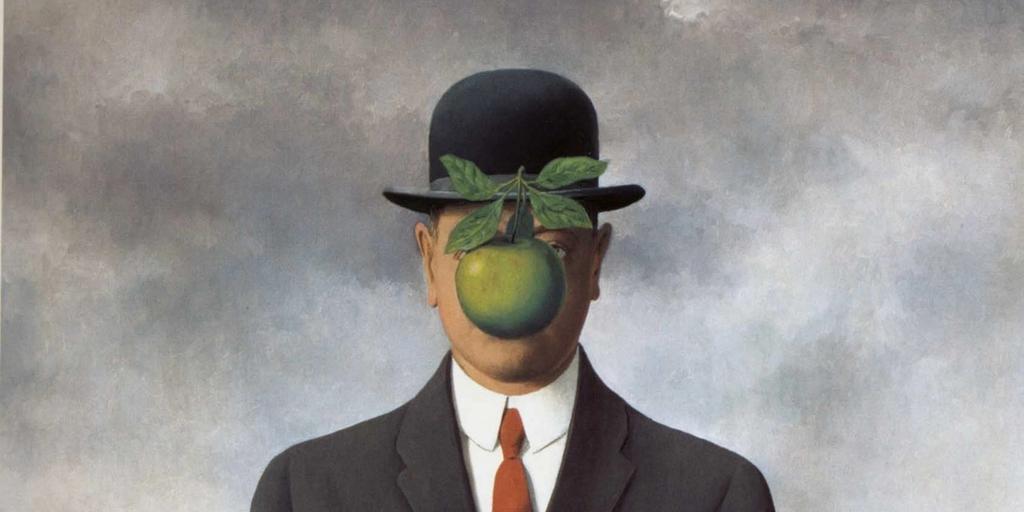
Magritte was obsessed with the idea of concealment and explored it repeatedly from different angles in his work. From the moment he was drawn to Surrealism, figures began appearing in his paintings whose faces are obscured by cloth, various objects or a haze. In Not to Be Reproduced, René went further still. He depicted a man with his back to the viewer and his face to a mirror — yet the reflection, unexpectedly, also shows his back. An even more cunning device is to place an easel bearing a painting in front of a landscape so that the painting blocks the view behind it, while at the same time depicting precisely what it appears to conceal.
When I look at my own paintings, I feel as though mystery surrounds me on all sides, and that there is no answer to it anywhere in the world.
The idea of the hidden preoccupied Magritte well beyond the narratives of his paintings. He disliked, for instance, interviews that had not been prepared in advance, precisely because such conversations gave too much away. It was in one such interview that he said: 'Everything we see conceals something else, and we always want to see what is hidden by what we see. There is an interest in the hidden — in what the visible does not allow us to see.' In his view, our interest in concealment can become a passion, a collision between the visible that is hidden and the visible that is revealed. For Magritte himself, the hidden became exactly that kind of passion — defining the subject of his work and shaping the riddles he posed to his viewers and to himself.
Repetitions and metamorphoses
Certain objects and images recur throughout Magritte's paintings: apples, bowler hats, birds, strange spheres, boulders and bilboquets. The last of these — an object resembling a chess piece, whose name is borrowed from a children's toy — takes on a different function each time: it can be a tree, a person, a musical instrument or a chess piece. Nude women also appear frequently in his work. In his drive to invest the human body with a sense of realism, Magritte painted Attempting the Impossible, in which a fully living woman emerges from the artist's brush.
In 1927 Magritte began exploring metamorphosis: 'I discovered a new potential in things — their capacity to become something else by degrees, the flow of one object into another, quite different from itself.' One such painting is Collective Invention — a mermaid in reverse, with human legs and a fish's head. The work also plays on the theme of concealment: the viewer is once again denied the chance to see a face. In his later period, continuing the theme of metamorphosis, Magritte experimented with the scale and materials of objects: he crammed a gigantic apple into a room or sent a stone bird soaring through the sky.
Titles and captions
Magritte examined the relationship between image and word. In 1927 he produced his first painting depicting various objects alongside captions — only one of which was correct. He made many such works. The most famous is The Treachery of Images, which shows a pipe beneath the inscription 'this is not a pipe.' He later painted a sequel in which a pipe floats in mid-air beside an easel holding the first version of the picture. In some works, René captioned not objects but amorphous forms, labelling them 'cloud,' 'tree,' 'horse.'
As a Surrealist, Magritte believed a painting was incomplete without a fitting title — one connected to the image indirectly or irrationally. He searched for titles at length and with great difficulty. He rejected the title 'Curtain Cords,' for instance, for a painting depicting mountains, because it called to mind ropes and mountaineering. 'Such an idiotic train of thought should not be encouraged, and we should in general try to avoid — as far as possible — titles that lend themselves to idiotic interpretations,' he wrote to André Bosmans. Although Magritte discussed titles at length with friends who were poets and philosophers, Georgette maintained that he almost never used their suggestions, preferring his own.
Theorems
One morning Magritte woke to find that a cage seemed to contain not a sleeping bird but an egg: 'The shock I experienced was provoked by the unexpected affinity between these two objects.' Inspired by this suddenly perceived connection, he set about looking for analogous affinities between other objects: 'Since this research yielded only one correct answer for each object, it resembled the search for the solution to a theorem.' Where once Magritte had simply surprised and fantasised, he was now, as he put it, 'working on theorems.'
To find the right image for a painting, Magritte would think and experiment at length. The process of tracing connections between different objects can be illustrated through the painting The Lovers' Perspective. If a hole is made beside a door, it becomes an equally valid exit from the room, serving the same function as the door itself. One can go further and place the hole in the door — and that becomes the solution to the 'theorem of the door.' Among Magritte's other theorem paintings: Rape is his solution to the 'theorem of woman,' and The Red Model is the solution to the theorem of shoes.
Other works by the artist
Interesting facts
- René Magritte rarely attended the Académie des Beaux-Arts where he studied. Yet when Georges Eekhoud — a noted Belgian socialist writer and lecturer in history and literature — was dismissed, Magritte led the student movement in his defence.
- The bowler-hatted man in Magritte's paintings is identified with the artist himself. Although the original version of The Son of Man came about in response to a commission to paint a self-portrait, Magritte himself did not begin photographing himself in a bowler hat until 1938.
- René Magritte detested what might be called obligatory cultural outings. On one occasion his wife and friends persuaded him to visit an exhibition. At the museum entrance, the artist announced that his dog Loulou had no wish to see the show, and went off to a café to drink liqueur.
- The titles of Magritte's paintings frequently contain references to his favourite films and books — among them works by Stevenson and Edgar Allan Poe.
- The philosopher Michel Foucault corresponded with Magritte and wrote the book This Is Not a Pipe, a meditation on his painting The Treachery of Images.
- In the Belgian town of Lessines, the house where Magritte's parents lived is now a museum holding a range of documents connected with the artist.
Read about other artists on Losko — for instance, about Edward Hopper and his architecture of solitude, or Frida Kahlo, one of the most remarkable artists of the twentieth century.
Follow us on social media so you never miss a new piece: VKontakte, Telegram — @loskomagazine.