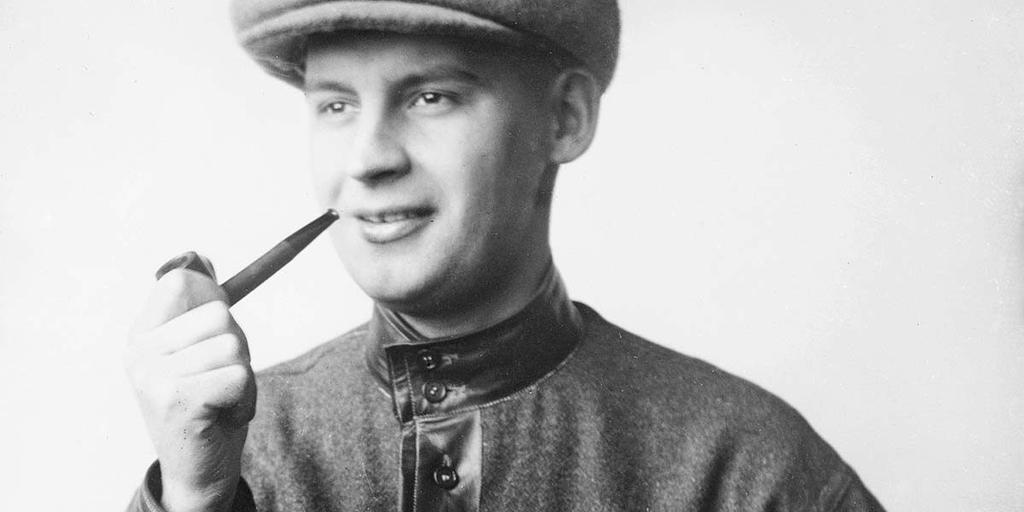
After the Revolution of 1917, young avant-garde artists, inspired by the idea of a society free from the old order, rapidly developed new creative directions, experimented with style and gave form to bold ideas. Alexander Rodchenko was one such figure: he pioneered new techniques in painting, advertising and photography. His distinctive angles, his handling of light, shadow and perspective, and his photomontage technique — hallmarks of the so-called 'Rodchenko style' — remain in use to this day.
In this biography you will learn:
- how the young Alexander Rodchenko first encountered the avant-garde and its leading figures;
- what role Vladimir Tatlin and Vladimir Mayakovsky played in his artistic development;
- how Rodchenko transformed illustration and photography in Soviet Russia;
- why his style is unique and how contemporary artists continue to draw on his techniques;
- why Soviet authorities suppressed Rodchenko's experimental style in the 1930s.

Rodchenko's Early Years
Alexander Rodchenko was born on 5 December 1891 in St Petersburg, the son of a theatre set designer and a laundress. From an early age the boy was immersed in the world of art: the family lived above a theatre and reached the street by crossing the stage. The backstage life, however, quickly bored him, and he had no wish to follow in his father's footsteps — indeed, his father hoped his son would find a 'proper' profession. After the family moved to Kazan in 1901, Rodchenko trained as a dental technician and worked in that field for several years, though medicine held no appeal for him.
In 1911 Alexander abandoned his profession to become an auditor at the Kazan Art School. Having left formal education after four years at a parish school, he had no certificate of secondary education and could not enrol as a full student. Nevertheless, after a year of successful study, auditor Rodchenko sat the entrance examinations and was admitted to the painting class.

'The Kazan Art School was remarkably tolerant of all kinds of innovation from its students. True, in that deep provincial setting, our "leftism" was very relative. For example, Nikitin and I were painting simultaneously in the manner of Vrubel and Gauguin — anything further left hadn't reached us yet.'
In 1913, at the school, Rodchenko met Varvara Stepanova, his future wife and collaborator. Stepanova was drawn to modernism and experiments with form and colour; together with her husband she would later stand at the origins of Constructivism. They organised exhibitions, took part in artistic groups, and worked ceaselessly to find and develop their own style.
'We will have a fantastic life together, won't we, Naguatta — we will live strangely? We will turn reality into a dream, and a dream into reality… To live in our own world, where there is no one but us!' So wrote Rodchenko to his beloved during a long separation, when Stepanova had gone alone to conquer Moscow. From that point on in their correspondence Varvara always appeared in the guise of Queen Naguatta, and Rodchenko as Leander the Fiery. During their time apart they wrote each other sonnets in a passionate, elevated style, rich in symbols and metaphors, conjuring in verse a world entirely their own.
In time, the couple would work as a single creative organism, inspiring each other — in avant-garde reportage photography and in the agitational fashion and textiles that occupied Varvara. The artist designed ornamental patterns for everyday clothing and developed practical uniforms for workers.
Wherever Rodchenko and Stepanova lived, their home became a creative workshop — a space that resembled a production studio, where something new was made every day and 'experiments for the future' were continually underway.


1914 proved a turning point in Rodchenko's life: he encountered the work of the Cubo-Futurists David Burliuk, Vasily Kamensky and Vladimir Mayakovsky at their performances in the Hall of the Nobility Assembly in Kazan. At the time, Russian Cubo-Futurism — a synthesis of Italian Futurism and French Cubism — was one of the most prominent artistic movements of the day. Non-objective art, free of rules and canons, appealed to the Kazan student, who had grown weary of a classical education.
Inspired by the performances of Burliuk, Mayakovsky and Kamensky, Rodchenko turned to Futurist art. He did not simply become an admirer of Futurist painting — he became a committed adherent. He sought to 'liberate painting' from formalism, working solely with space and form: 'I prefer to see extraordinarily ordinary things… I have found the one truly original path. I will make things live like souls. I will find things in people…'

The beginnings of Moscow life and the first exhibitions
At the end of 1915, Alexander Rodchenko followed his beloved to Moscow. Through mutual friends, the young painter met Vladimir Tatlin, one of the leading Moscow avant-gardists. Tatlin was then organising the Futurist exhibition 'The Store' and invited Rodchenko to participate in exchange for help with the organisation. It was the artist's first exhibition.
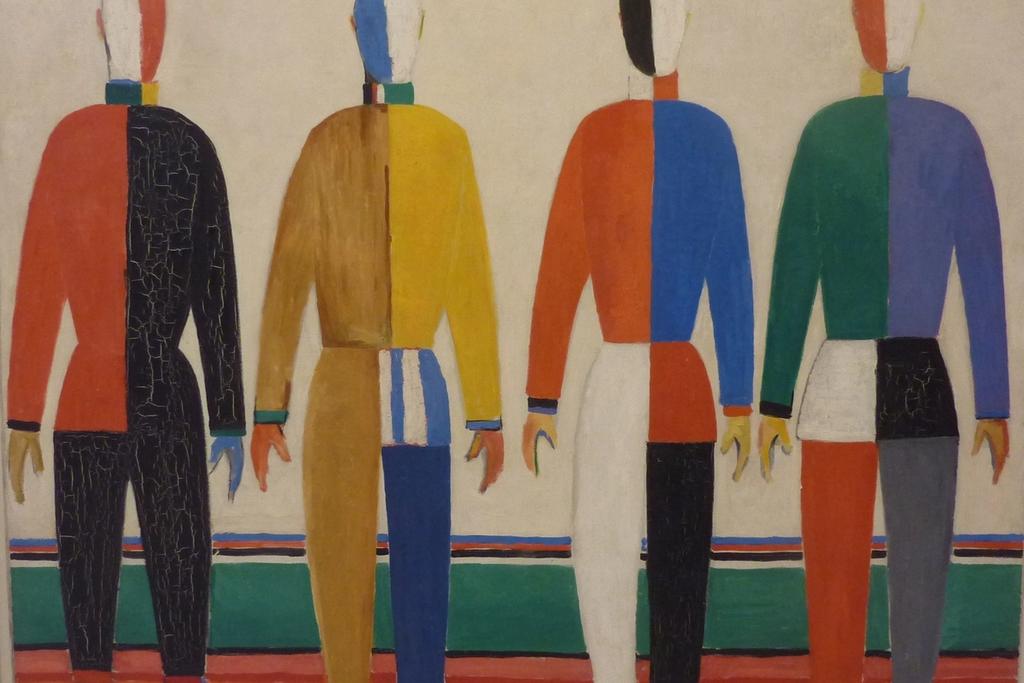
While organising the exhibition, Alexander came into contact with other celebrated artists. Yet the Suprematists, led by Kazimir Malevich — with his profound philosophical ideas about pure art and his interplay of geometric forms and tones on canvas — left the painter unmoved. What repelled the idealist Rodchenko was Malevich's insincerity and self-regard. Malevich's conceptual approach held far less appeal for him than Tatlin's monumental sculptures, in which form took precedence over content and practicality became the foundation of the work. Rodchenko chose art free from any ideological underpinning.
Working with Tatlin marked the next significant stage in Alexander's creative life: texture became the centre of his pictorial method and style, and he continued his experiments with form. Non-objectivity lay at the heart of his early work. By layering varied forms one upon another, the artist constructed deep space, turning flat planes into three-dimensional structures. For many of his ideas Rodchenko drew on monographs about astronomy, mathematics and physics, expressing on canvas the pure energy and laws of the universe.
'From him [Tatlin] I learned everything: the attitude towards one's profession, towards objects, towards materials, towards sustenance and towards life as a whole — and that left its mark for the rest of my life… Of all the contemporary artists I have ever met, there is none his equal.'


Constructivism and 'the end of painting'
In October 1917, the avant-gardists began actively collaborating with the Bolsheviks. They founded a trade union of painter-artists, in which Rodchenko took the position of secretary of the Young Federation. He supported the new Bolshevik regime, aligned himself with left-wing ideas and took part in the majority of the party's artistic projects. For several years Alexander worked at the People's Commissariat of Enlightenment, then became a member of Zhivskulptarkh — the commission attached to the Commissariat that developed the stylistic language of Soviet avant-garde architecture — and was one of the founders of RABIS, the Union of Art Workers. At that time it was the artists themselves who determined how Soviet 'art for the people' would develop.
At Zhivskulptarkh, Rodchenko developed the concept of the 'city with an upper façade'. He believed that in the future, thanks to new technologies, people would fly over cities and admire the urban landscape from an unfamiliar vantage point — from above. He designed structures, walkways and suspended modules on the rooftops and walls of buildings, which were to become the 'upper façade of the city'. Such a perspective would open up unique views for the observer — a new way of seeing the everyday.
In 1920, the first Constructivist association was formed — a group of new artistic vision in Soviet Russia. Its members held that creative work must be utilitarian: practical, convenient, with forms that were as simple and memorable as possible. The Soviet government supported these ideas, since the approach aligned with Bolshevik ideology regarding art for the people — so-called 'production art'.
In 1921, Rodchenko declared the 'end of painting': 'I have brought painting to its logical conclusion. I exhibited three canvases: red, blue and yellow. It is all over.' 'Art for art's sake' was dead, the artist maintained; a new chapter in the life of the country had begun.

At the same time, Alexander Rodchenko began teaching at VKhUTEMAS — the Higher Art and Technical Studios. Constructivist instructors taught 'production art': students learned to design multifunctional objects by exploiting the possibilities of form and transformable structure. The beauty of the new art was born from practicality and utility. Many VKhUTEMAS graduates went on to become leading Soviet designers.
Photomontage and Advertising
In the 1920s, Rodchenko moved away from painting, resolving to become an 'artist-producer' and devote himself to the most quintessentially Soviet art forms — collage and the poster. During this period the artist-constructor designed more than a hundred advertising posters, contributed to the cover design of every issue of the Left Front of the Arts journals, illustrated books, and directed the stage design of productions at the State Theatre named after Vsevolod Meyerhold.
Rodchenko was the first in the USSR to create photocollages and photomontages: for collage he used clippings from magazines, while for montage he shot photographs specifically for the purpose. The advantages of photocollages and posters for an avant-garde artist were self-evident: concision and visual impact, a wide choice of materials and compositional possibilities. For Rodchenko, this became the new industrial subject matter he had long sought — art unlimited in its scope for experiment and put to practical use in society.
Before long, photographs began to displace clippings in Rodchenko's posters, and montage effectively replaced collage. His wife Varvara, himself and his friends served as models. The Constructivists favoured photography and photomontage over hand-drawn graphics, yet Alexander recognised that such techniques constrained the dynamism of his work. Photography, meanwhile, fulfilled several functions at once: it defined the structure of the poster, reinforced the advertising message and sustained the compositional order.
In 1920, at an exhibition, Alexander met Vladimir Mayakovsky and his lover Lilya Brik. A long artistic partnership and close friendship took root: to Mayakovsky, Rodchenko was 'the old man', while Rodchenko called the poet Volodya. The master later published a text titled 'Working with Mayakovsky', in which he wrote about his collaboration with Volodya, about time spent at the 'Briko-Mayakovsky' household in Moscow and at their dacha in Pushkino. Rodchenko also dedicated a chapter of his autobiography, Experiments for the Future, to his comrade.
Lilya Brik, the 'muse of the Russian avant-garde', became one of the photographer's principal models: it is Lilya who urges Soviet youth to buy books in the widely recognised poster for the Leningrad branch of Gosizdat — a classic example of the visual interpretation of speech.
A creative partnership took shape: Alexander Rodchenko joined forces with Vladimir Mayakovsky to form the collaborative studio Reklam-Konstruktor "Mayakovsky — Rodchenko." Rodchenko was responsible for the graphic composition; Mayakovsky handled the text. The Futurist poet accompanied each piece of copy with a sketch in a satirical vein, but the final design decisions rested with Alexander. Both men took the work seriously, regarding advertising as a literary and artistic weapon. The output of Reklam-Konstruktor "conquered" Moscow and transformed the old style of commercial art. Posters for GUM, Mosselprom, Rezinotrest and other Soviet organisations left their mark on the visual and everyday culture of the 1920s and 1930s.
"Advertising is the name of a thing. Just as a good artist makes a name for himself, so a thing makes a name for itself… Advertising must remind people endlessly of every item, even a wonderful one." V. V. Mayakovsky, "Agitation and Advertising"


A revolution in photography
From 1924, Rodchenko devoted himself entirely to photography. It was then that his avant-garde style began to take form — a style that would amount to a genuine revolution in art. His first photographic series comprised six portraits of Mayakovsky, taken in Rodchenko's studio on Myasnitskaya Street. He went on to photograph friends and family, the people who mattered most to his creative life: the Briks, A. M. Dovzhenko, his mother. He shot without the characteristic chiaroscuro, backdrops and generalisations typical of portrait studios. Moscow — a modern, industrial, rapidly evolving city straining towards the future — became the primary setting for his early photographic experiments in the urban environment.
Rodchenko's approach grew ever more saturated with the aesthetics of Constructivism, conveying "dynamism within the object" and accentuating the spatial and volumetric qualities of the image. He sought to make every photograph unique through new techniques. One of these was the dramatic angle: familiar, everyday things appeared strange to the viewer when seen from an unexpected vantage point. His signature perspectives — looking sharply upward and looking steeply downward — were a breakthrough within the canonical photographic art of the 1920s.
The second revolutionary device was the diagonal — the foundation of his composition. A line organised space and animated the subject being depicted. And the double exposure, used in a number of his photographs, transformed a static frame into a moving film reel.
Rodchenko's primary colours were black and white. He also made extensive use of grey tones. His palette reinforced angle and composition. The photographer employed other artistic principles to construct space as well: close-up, chiaroscuro and perspective. Together these gave his images a heightened expressive power.
The experimentalist wanted to capture unusual frames by shooting mundane situations: 'I want to teach people to see extraordinarily ordinary things.' The Soviet reality then being built proved an ideal field for Rodchenko.
Contemporary photographers draw on principles developed by the Russian photographic tradition: artists 'distort' composition and perspective, deploying colour palettes in rhythmic ways. In the second half of the 1920s, as totalitarianism was taking hold in the country, Alexander Rodchenko managed to find freedom for creative work. He showed that boldness and freedom from canon are the very foundation of photography — an idea that continues to shape art today.
The twilight of his career and his legacy
In 1928 the journal Sovetskoe Foto accused Alexander Rodchenko of copying Western art. It was the beginning of the end: the Soviet authorities, who had initially supported creative innovators, proved unprepared for experimental photography. The general tightening of the regime as it hardened into totalitarianism made matters worse. Avant-garde artists were accused of formalism — a blow that struck Rodchenko particularly hard, given his wholehearted commitment to Soviet power and socialist ideals.
The romantic impulse of Rodchenko's work gave way to restraint: photography now had to follow the dictates of Soviet propaganda. On party commissions he shot reportages for albums and newspapers, but the spirit of avant-garde photography had been broken.
In 1938 Rodchenko and Stepanova produced a ceremonial album about the coming changes to the capital planned by the Moscow City Soviet — Moscow Reconstructs. They were to present the planned transformations to the city's residents in an accessible, artistic form: capturing urban life in photographs and graphics, conveying the momentum of Moscow's advance towards a bright future. The album became a landmark of printing art, combining graphic design, photography, cinematic narrative and three-dimensional constructivist inserts.
In the late 1930s Rodchenko withdrew from political art, having grown definitively disillusioned with the authorities and come to understand that he could no longer serve as a mouthpiece for the totalitarian regime. His interests ended where politics began. During this period he worked in theatrical set design, photographed circus performers, and turned to pictorialism — a current that brought photography closer to Impressionism and Art Nouveau.
He also returned to painterly techniques, with the circus becoming his central subject. From an early age, Rodchenko had loved clowning, performed magic tricks and played pranks. For him, the performance was a metaphor for life: dazzling feats, the wonder of light, yet at the same time the danger and vulnerability of every individual. It was not mere entertainment for the spectator, but life shown from the inside.
The difficult period of Rodchenko's creative life is captured well by his daughter's words: 'Papa! I would like you to spend this year making pictures for literary works. Don't think I want you to do everything in socialist realism. No — I want you to be able to do things the way only you can do them. And every minute, every day, I remember that you are sad and not drawing. I think you would be happier then, and you would know that you are capable of doing such things.'
Conclusion
Alexander Rodchenko was a true experimenter, the founder of a school of technical Constructivist aesthetics: he saw his purpose as the breaking of the ossified and the traditional. The artist found his inspiration in the subjects of everyday life. It was through these that he revealed his character — in life he was a reserved man who allowed himself no sentimentality in company, yet his subjects disclosed an extraordinary temperament: energetic, resolute, and driven.
In his final years Rodchenko fell into depression; his diary entries are filled with pessimism. He complained that life was growing more tedious with every passing day and that there was no work to be had. For the Rodchenko–Stepanova partnership, a dark chapter had begun.
In 1956, Alexander Rodchenko died before seeing his first solo exhibition, which was organised by Varda Stepanova.
His final years transformed Rodchenko's view of the power and possibilities of Soviet art: he abandoned the search for the new in the everyday and submitted to the laws of socialist realism imposed by the totalitarian state.
Rodchenko's bold legacy has left its mark on history — an art that stands as a monument to avant-garde culture, transcending time and place. Contemporary artists, photographers and designers continue to draw on his vivid imagery, return to his distinctive techniques, and work with the same liberated art that Alexander Rodchenko once championed.
Interesting facts:
- In 1925, at Vladimir Mayakovsky's suggestion, Alexander Rodchenko took part in the Exposition Internationale des Arts Décoratifs et Industriels Modernes in Paris. He presented a workers' club project — a multifunctional interior system — along with posters developed by the Reklam-Konstruktor studio. For this he was awarded a silver medal in the Street Art category.
- In 1925, Rodchenko spent two months in Paris — the only journey abroad he ever made. The French capital, widely regarded as the world's leading centre of artistic life, left the avant-gardist unimpressed. He was struck by how underdeveloped advertising was in Paris, and by how bourgeois and frivolous the city's intelligentsia seemed in their pastimes. In Alexander's view, French art amounted to nothing more than the decoration of life. Compared with the USSR, Paris was, in terms of artistic taste, a mere province.
- In the early 1930s, Rodchenko established a photography group within the Oktyabr creative association, which brought together leading artists working in the industrial arts. In 1932, the association was dissolved following accusations of petty-bourgeois aestheticism, and Alexander was forced to abandon photography for several years.
- Alexander Rodchenko titled his autobiography Black and White. Like every artist, his life had its dark periods and its bright ones. That interplay of colours also defined his fundamental creative territory as a photographer: two colours and the many shades of grey lying between black and white — a range through which every tonal nuance of the subject could be expressed.
- In 2006, the Rodchenko Moscow School of Photography and Multimedia was founded in Moscow, specialising in education in contemporary art, photography and video art. The master's grandson, Alexander Lavrentiev, teaches at the school.
Also read the biography of El Lissitzky and Wassily Kandinsky.
Follow us on social media so you never miss new content: Telegram.