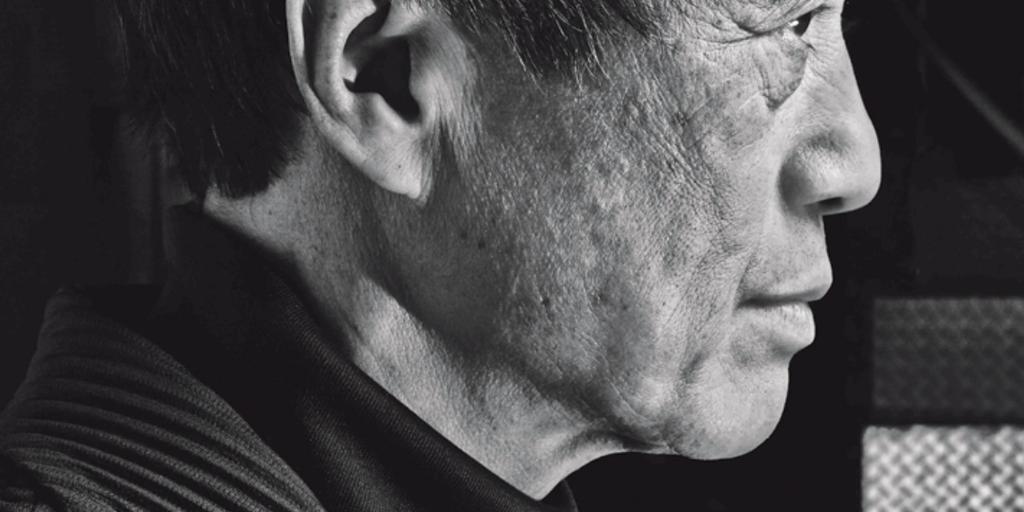
Tadao Ando is one of Japan's most celebrated architects. In his work, concrete becomes as smooth as silk, and buildings themselves become extensions of the landscape. With no formal architectural training, he was awarded the Pritzker Prize and now teaches at leading universities in Japan, the United States and Europe.
In this article you will learn:
- how a young Tadao decided to become an architect;
- who his idol was;
- why it is difficult to live in Ando's houses;
- what the architect spent his Pritzker Prize money on.

Family, childhood and the decision to become an architect
On 13 September 1941, twin boys were born in Osaka — Takao Kitayama and Tadao Ando. It was an extremely difficult time for Japan, and two years later their parents made the decision to give one of the children to his grandmother to raise. The choice fell on little Ando.
He and his grandmother lived in a poor working-class neighbourhood of Osaka. Their home was typical of Japan in the 1940s — built from wood, with little light inside and walls that let in the wind. Ando retained very warm memories of his childhood home, and has said that it was his cave and that he loved it there.
He grew up as a wilful, independent child. His grandmother never spoiled him and actively encouraged his self-reliance. In his youth, Ando often got into fights and made no effort to suppress his emotions. When Tadao was twelve, the house needed repairs and carpenters came to work on it. The young Ando was thrilled by how the space had been transformed, and decided that he too would become a carpenter or an architect.
A self-taught architect
There was no money in the family for formal education, so Ando had to start earning early. Pursuing his dream, he tried working at various architecture firms but never stayed anywhere for long — he was let go each time for being too stubborn. He had a tenacious character from childhood, a quality honed by his years of boxing. Once he set a goal, he would see it through. And so he began to teach himself architecture.
In a shop across the road from his home, Tadao Ando found a book by Le Corbusier. It was expensive at the time, and the boy saved up for several weeks. When he finally bought it, he leafed through it so many times that the pages nearly wore away. Ando has admitted that in his early work he constantly asked himself — how would Le Corbusier have done this? He later even named his beloved dog after the great architect.

At eighteen, Tadao Ando began visiting temples, churches and teahouses in Kyoto and Nara, studying the principles of traditional Japanese architecture with his own eyes. In the 1960s he started travelling through Europe and America to observe Western architecture, continuously writing down his impressions of everything he saw.
French architecture had a profound influence on Ando's work. He was particularly struck by Le Corbusier's Unité d'Habitation in Marseille and the Chapel of Notre-Dame du Haut. The minimalism and dynamism of those concrete buildings, and their carefully considered play of light, captivated him and became the foundations of his own style.
The Beginning of a Career
On returning to Japan, Tadao Ando passed his examinations, obtained his architectural licence and opened his own studio in 1969. He was 28 at the time, and no one wanted to hire a self-taught architect with no professional experience. But Ando was accustomed to overcoming obstacles and kept pressing towards his goals.
Initially he designed small wooden houses, furniture and interiors. His first serious client was a young family with a child who wanted to renovate their existing home. By the time Ando completed the work, however, the couple had had twin daughters, and the small house was no longer suitable for the growing family. At that point Tadao Ando's firm had no office of its own, so he decided to buy the house from his clients and use it as a workspace. He went on to renovate it many times before eventually demolishing the building and constructing the firm's current office.

In the early years Ando worked on private commissions. His style was not to everyone's taste, but looking back at those early projects today, one can immediately recognise the architect's signature hand. Clients valued his understanding of space, and many have lived in the homes he designed for decades. Ando recounts that a woman who grew up in one of his early houses in Kobe approached him 30 years later with a request to build her exactly the same kind of house — only in Tokyo.
"Here I feel every shift in the weather on my skin. Sometimes the house makes me angry, sometimes I love living in it, and sometimes it challenges me. But I never tire of those sensations" — says one of Ando's clients, who has lived in the house he designed for 35 years.
International Recognition
Tadao Ando's favourite material is concrete. In his projects it is invariably of flawless quality and smooth as silk, and it has become his calling card. This scrupulous attention to detail has earned Ando recognition far beyond his home country and a wealth of international awards.
Having received the Pritzker Prize in 1995, Ando established a foundation to give thousands of children access to a quality education. His other honours include the Gold Medal of the French Academy of Architecture, several awards from Finland, the United States, the United Kingdom and Denmark, and, of course, Japan.
Without a university degree, Tadao Ando teaches at Ivy League institutions in the United States, among them Yale, Harvard and Columbia. He also gives periodic lectures at Princeton, Berkeley and various colleges in England, France and other countries.
At Ando's office, a single architect works on each project. To this day Tadao keeps close watch over every project: he works side by side with each member of his team and insists that they produce drawings by hand. No one is permitted to rest until the work is finished. All organisational matters for the firm are handled by his wife, Yumiko Ando.
Notable Projects
Azuma House, Osaka, 1976
One of Tadao Ando's earliest projects, the private Azuma House stands in the Sumiyoshi district. At the time most houses in the area were built of wood, but Ando erected a minimalist concrete structure whose façade resembles a box. From the outside the house shielded its occupants from the street: there were no windows facing outward. Inside, however, the architect brought the residents face to face with the natural environment by placing an open courtyard at the very centre of the building. When it rained, the owners had to use an umbrella to cross from the living room to the bathroom. In 1979 the house received an award from the Architectural Institute of Japan, and Ando became a household name in his country.
Koshino House, Ashiya, 1980–1984
Another of Tadao Ando's celebrated projects is the house he designed for Hiroko Koshino. The architect conceived it as an extension of the hillside, placing certain parts of the building below ground. In this way he preserved the natural slope of the site and made the house a continuation of the landscape. The building consists of two parallel wings connected by an underground passage. All the walls are made from the architect's favoured material — concrete. Large glass windows draw in light and open onto a picturesque view of the garden and hills.
Once again, Tadao Ando allowed the external environment to flow into the interior. The owner, Hiroko, joked that in winter she was forced to walk through the house in a ski suit because of the unbearable cold. And during rainfall, certain parts of the house let in water — by the architect's own design.
Church of the Light, Osaka, 1989
One of Tadao Ando's best-known works is this church in a suburb of his native Osaka. The building appears strikingly simple: a minimalist concrete box with glazed apertures in the east wall, through which sunlight enters and forms a luminous cross within the darkened space. The concrete deepens the darkness, creating a modest and meditative place of worship, while the cross in the wall remains the only religious symbol present in the church.
Ando's choice of the east wall for the cross was deliberate. It allows the maximum amount of light to enter the church during the morning hours, so that those who come here can be fully absorbed in reflection and prayer. The reinforced concrete building is entirely free of ornament. The joints and seams were constructed with exceptional care by master carpenters working under Tadao Ando's direction, in order to achieve a flawlessly smooth surface. Calm, emptiness, simplicity, light and shadow — all of these are tools Ando employed to express his philosophy of the duality inherent in the world around us.
Water Temple, Hokkaido, 1988
"By placing the cross at the centre of flowing water, I wanted to express the idea of God existing in the heart and mind of the individual," Ando has said of the Water Temple. The architect has always paid close attention to the natural landscape, using it as an element of design. He built the church's foundation on a slope leading down to a river and a grove of beech trees, and replaced the front wall of the shrine — where the principal sacred image would traditionally have been placed — with a glass wall. It creates a living, multi-coloured and constantly changing scene: the viewer witnesses the most varied gradations of light, season and temperature.
Modern Art Museum of Fort Worth, 1997–2003
Simple geometry, engagement with the natural environment and a resolutely minimalist palette of materials — Tadao Ando's distinctive style brings something of Japan to every project he undertakes. Five long flat-roofed pavilions appear to float on the surface of a reflecting pool.
The minimalist character of this large building is achieved through the use of plain materials: concrete, steel, aluminium, glass and granite. Abundant light and the reflections on the surface of the pool together create a sense of weightlessness, while the museum's surroundings are every bit as beautiful as the works of art held within.
Sharp, clean lines and massive walls generate a dynamic tension that meets the soft boundary of the surrounding pool. Cantilevered cast-concrete roofs support linear clerestory windows, admitting generous natural light into the interior. The five Y-shaped columns have become the museum's defining motif.
Hill of the Buddha, Hokkaido, 2016
In northern Japan, Tadao Ando designed a lavender-covered temple that encircles a giant statue of Buddha. Before Ando began work on the project, the 44-foot sculpture had stood alone in a field for fifteen years.
The completed temple envelops the statue, leaving only the crown of its head visible. The hill, planted with 150,000 lavender flowers, changes its appearance with the seasons: green in spring, purple in summer, and white in winter. Visitors approach the Buddha through a 40-metre approach tunnel running beneath the hill.
The architect's intention was to create a vivid spatial sequence that would heighten anticipation of the statue, invisible from outside. Entering the hall, visitors look upward and see the head of the Buddha surrounded by a celestial halo.
Benesse Museum, Naoshima, 1992
In this project, Tadao Ando once again pursues his concept of uniting nature, art and architecture. Built on elevated ground, the museum's façade opens onto the Seto Inland Sea and its magnificent natural surroundings. Over the years, the building complex has become ever more deeply integrated with the natural environment of Setonaikai National Park.
Benesse House comprises four buildings: the Museum, the Oval, the Park and the Beach. The Museum opened in 1992, and a small hotel followed almost immediately. Works are displayed not only in the museum galleries but throughout every part of the buildings and the surrounding grounds — some pieces can be found along the shoreline or in the forest. Here, guests are invited to explore art, nature, architecture and their own thoughts in a layered, multifaceted synergy.
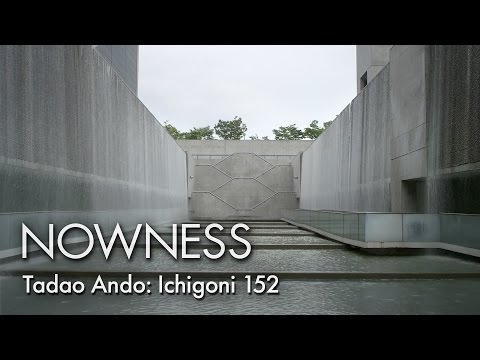
An interview with the architect about the Ichigoni 152 project
Notable Quotes
- "I believe that the emotional power of architecture comes from the way we introduce elements of nature into architectural space. Rather than creating complex forms, I therefore choose simple geometry in order to draw subtle yet dramatic lines of light and shadow through space."
- "It might seem as though anyone could do what I do. But that is not the case. No one can replicate my architecture."
- "Architecture should not say too much. It should remain silent and allow nature to tell everything that needs to be told."
- "You cannot simply build something new. You have to take account of — and absorb — everything you see around you: what the land is like and what is already there. Only then can you think about how to interpret it."
- "I love making things with my own hands. But I cannot build a house on my own. Every time I hand my drawings over to the workers, I feel a deep anxiety, because I cannot take part in the construction myself."
- "I am interested in discovering what can be drawn out and developed from living under harsh conditions. I also believe that order is essential for giving life its dignity. Imposing order places certain constraints on people, but I am convinced that it cultivates extraordinary qualities in them."
- "Whenever I see a beautiful Japanese room, I am struck by our understanding of light and shadow. A ray of light drawn into an empty space creates dim, quiet shadows. In that small corner, there seems to reign an absolute silence and an unchanging serenity."
Follow us on social media so you never miss new content: VKontakte, Telegram.