You have almost certainly come across photographs of these buildings on Pinterest, but few people have looked into the stories behind their construction. The Losko editorial team has put together a selection of those very Soviet buildings, complete with their sometimes remarkable, strange and even melancholy histories.
The Ministry of Road Construction Building in Tbilisi

Address: 29a Gagarina Street, Tbilisi
Architects: Georgy Chakhava, Zurab Jalaghania
Engineers: Temur Tkhilava, Alexander Kimberg
Year of construction: 1974
This whimsical structure, resembling a sprawling oak tree, is the work of the gifted architect Georgy Chakhava. He dreamed of realising the idea of a "city-space" in which buildings would blend organically into the natural landscape. The opportunity arose through a fortunate coincidence — Chakhava was himself Deputy Head of the Georgian Ministry of Construction when a new headquarters was needed in Tbilisi. As both client and contractor in one, he was free to create, in 1975, a building that was rare for the Soviet Union.
Rising to eighteen storeys at its highest point, the building stands on the rocky bank of the Kura River. The vertical sections house staircases and lifts, while the two-storey horizontal sections contain functional office zones. Although the architectural solution may appear precarious, the ministry building has towered above the cliff for nearly forty years, repeatedly withstanding the region's frequent earthquakes. Just as Chakhava intended, it coexists peacefully with the surrounding nature: shrubs and trees grow between the load-bearing columns, a small stream runs beneath them, and ivy has colonised the building's northern façade. The building currently houses the offices of the Bank of Georgia.
Druzhba Holiday Centre in Kurpaty, Crimea

Address: Kurpaty, 29a Gagarina Street
Architects: Igor Vasilevsky, Yu. Stefanchuk, V. Divnov, L. Kesler; engineers Nodar Kancheli, B. Guryevich, E. Vladimirov, E. Ruzyakov, E. Kim, V. Malts, V. Gansgorie, E. Fedorova.
Year of construction: 1985
The "flying saucer", familiar to anyone who has ever holidayed in Crimea, is a joint project by Czech and Soviet architects. The Czech side insisted that the sanatorium be situated on the Golden Beach, yet there was little room for choice: only one small and highly inconvenient plot remained free along the shore. Landslides, seismic activity of up to magnitude 8, a forty-degree incline — these conditions demanded a bespoke design. The architects chose the form of a "three-legged stool", which allowed the load to be distributed evenly across the unstable slope. As a result of this solution, the only way to enter the holiday centre is from above, approaching it from the road along a glazed bridge.
The functional body of the sanatorium takes the form of discs stacked one upon another, which from above resemble toothed cogs. Around the perimeter of the large two-storey discs are 400 rooms with loggias, angled so that guests cannot see into one another's space. At the top is an open-air terrace, from which visitors can take in a sweeping view of the sea. Higher still, three smaller "cogs" house the restaurant. The central part of the building is occupied by an atrium that serves as a communal space. Daylight floods the interior through glass walls and a roof dome, while beneath the floor is a pool of seawater, visible through a transparent triangle set into the centre of the hall. Since 1985, the sanatorium building has stood firmly on the hazardous slope and has so far required no reconstruction.
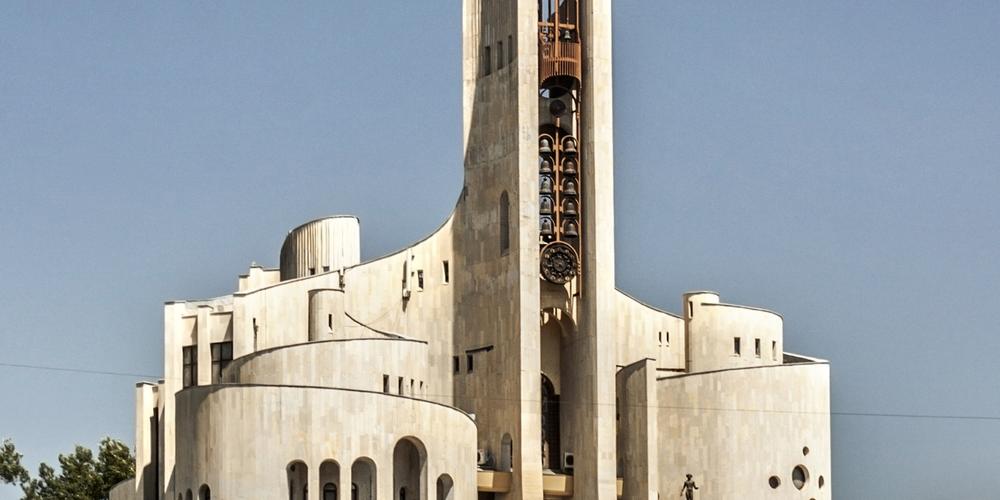
Palace of Solemn Ceremonies in Tbilisi, Georgia

Address: Tbilisi, 21 Bochorma Street
Architects: Viktor Jorbenadze, Vazha Orbeladze
Year of construction: 1985
The imposing wedding palace in Tbilisi is the best-known work of Vladimir Jorbenadze, nicknamed Jorbusier for his passion for the projects of Le Corbusier. The building, completed in 1984, was visited by Margaret Thatcher as early as 1986, and four years later served as the venue for the wedding of Deep Purple vocalist Ian Gillan. The original design was a fusion of Jorbenadze's personal architectural vision and the need of the atheist Soviet state to compete with the splendour of religious wedding ceremonies. The palace's façade is clad in local stone, while the interior opens into a spacious atrium with an altar at its far end. The atrium walls are adorned with frescoes, and the windows with stained glass.
The unusual building soon became a subject for reflection: a separate theory even emerged about its symbolic meaning. According to this theory, the wedding palace does not merely serve its function but itself represents the union of the masculine and feminine principles. The building's design can indeed be seen as resembling an image of the female reproductive system, while its exterior takes a phallic form. Jorbenadze's mother was a gynaecologist, which supporters of the theory believe influenced the architect's creative work. He himself was a free-thinking man: he read Le Corbusier in French and was friends with the dissent-minded director Sergei Parajanov. The palace is currently in private ownership and, unfortunately, cannot be entered.
Kyiv Crematorium, Ukraine

Address: Kyiv, Baikova 16
Architects: Avraam Miletsky, Ada Rybachuk, Volodymyr Melnychenko.
Year of construction: 1975
Were it not for the artists Ada Rybachuk and Volodymyr Melnychenko, the Kyiv Crematorium would look entirely different today. Purely functional, practical, featureless — that was how its lead architect Avraam Miletsky envisioned it. But the artists he invited refused to approach the work with indifference. In this project they wanted to convey the significance of every human life. The concrete hemispheres, dynamically oriented towards the sky, were conceived as a monument to life in its ceaseless motion. Rybachuk and Melnychenko called them the Temple of the Sky.
The crematorium building was intended to form part of a large-scale memorial complex called the Park of Memory, which, sadly, was never realised. Around Baikove Cemetery, above which the crematorium stands, the artists erected the second part of the complex — a two-hundred-and-thirteen-metre wall. It was covered in bas-reliefs depicting scenes familiar to all from human life: birth, love, motherhood, war. The artists poured into these sculptural images the memory of all humanity. The wall was meant to help people who had lost loved ones to work through their grief and reflect on life. Rybachuk and Melnychenko had already spent seven years working on the bas-reliefs when the Soviet authorities deemed their work demoralising and had the images filled in with concrete. In 1992, the decision to destroy the wall was officially reversed, but the monument has never been restored.
The F. M. Dostoevsky Academic Drama Theatre, Veliky Novgorod

Address: Veliky Novgorod, ul. Velikaya, 14
Architect: Vladimir Somov
Built: 1987
The drama theatre building in Veliky Novgorod resembles a conquering spaceship that landed and could not take off again. The glass-and-concrete giant provokes shock and bewilderment among residents, fitting entirely out of place in the architecture of this ancient city. The theatre was intended to become the cultural hub of Veliky Novgorod, and a generous square was set around it to host city festivals and celebrations. Fountains have been installed on it, along with the water towers needed to run them. The square itself is paved with specially designed concrete modules.
The drama theatre building is a monument not only to Soviet modernism but also to the period's ambitions, far removed from reality. The Union's leadership expected that by 1987 Veliky Novgorod would have grown so substantially through the planned economy that the theatre and the square would be packed with people. Those plans were never realised: the brutalist theatre proved too large for the city, and now, abandoned and dilapidated, it looms threateningly on the bank of the Volkhov River. Grass grows in the fountains that were never switched on. The stele beside the theatre, made from the same modules that pave the square, was nicknamed the suicide column by locals and was demolished in 2009.
If you enjoyed this selection, we also recommend looking at 10 projects by the architect Le Corbusier or Arata Isozaki
Also follow us on social media so you never miss new content: VKontakte, Telegram.