If you have long since watched all the TED Talks by Pritzker Prize laureates, read every guide to Moscow, and your interest in architecture and urbanism shows no sign of waning, below you will find a selection of 10 books written by professionals for architects and urbanists, as well as for enthusiasts and the generally curious.
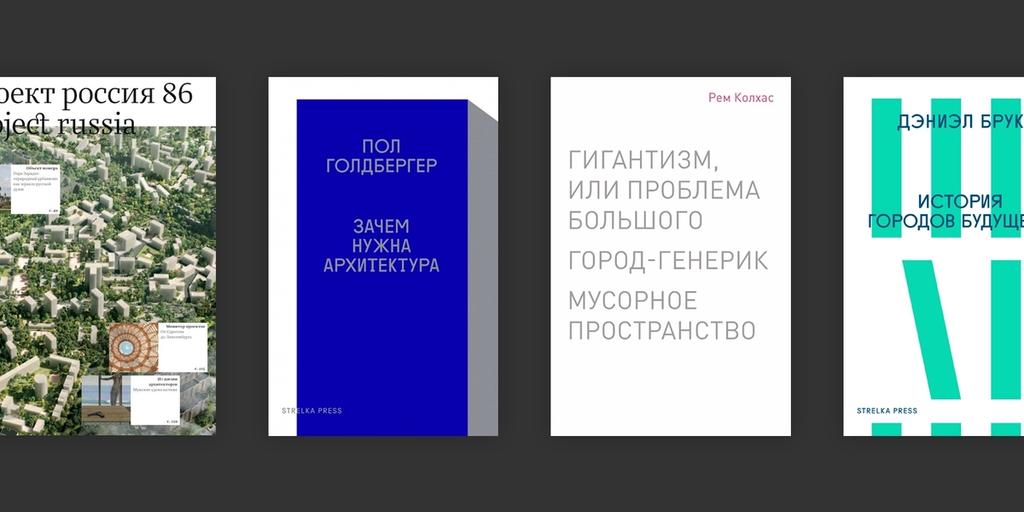
Paul Goldberger, Why Architecture Matters

If you have ever genuinely asked yourself this question, Pulitzer Prize-winning architecture critic for the New Yorker and Vanity Fair Paul Goldberger is here to help you answer it. The book is remarkably eclectic: the author's personal, subjective responses to different architectural environments sit alongside thoroughly practical reflections on geometric form in architecture and the intelligent use of multi-storey space. Goldberger also turns his attention to the history of architecture, its impact on the urban environment, and the perennial question of how functionality and aesthetics relate to one another in a building. In this way, Why Architecture Matters does not simply answer the question posed by its title — it raises new ones, which author and reader work through together.
Print edition — 569 rub.
Daniel Brook, A History of Future Cities

Daniel Brook examines four cities that each became, in their own era, magnets for the most advanced, innovative and enduring ideas their world had to offer. St Petersburg, Mumbai, Shanghai and Dubai — cities in which the leap from old to new, from entrenched tradition to the avant-garde, from the conservative to the cosmopolitan, first took hold. The defining architecture of these cities gives physical form to that leap, whether in the shape of a lavish palace modelled on the finest churches of Europe, mass housing built from local limestone, or a foreign skyscraper reproduced not once but twice. This is a compelling architectural guide to the ambitions, aspirations and hopes of four great metropolises.
Print edition — 350 rub.
Colin Ellard, Places of the Heart: The Psychogeography of Everyday Life

Colin Ellard investigates the influence that our surroundings exert on us as human beings. In this book he asks how buildings shape the way we feel and the way we perceive the world around us. Why do we feel uneasy in a forest of artificial plants, however skilfully they are crafted and however sophisticated the neural network controlling them? Why are rats that live in purpose-built rat houses more intelligent than those kept in shoeboxes? How can a building strengthen a person's faith in God? These questions — and many others — find their answers in Places of the Heart. If you still don't know what psychogeography is, this book is most certainly for you.
Digital edition — 379 rub.
Christopher Alexander, Sara Ishikawa, Murray Silverstein, A Pattern Language

The authors of this book believe that the finest buildings are produced not by star architects but by ordinary people. It follows that a home should be designed by its owner, not a hired professional, and that a city park is better entrusted to the residents of a neighbourhood than to an outside designer. A Pattern Language contains hundreds of concise, substantive entries that illuminate the fundamental principles of construction and explore how individual elements interact within a coherent living environment. From the book you will learn how to design sports facilities, pedestrian crossings, maternity wards and spaces for teenagers, how to plan a home's lighting, arrange shelving in a living room, and create a space for play. A Pattern Language is a true toolkit for the engaged urbanist or the hands-on homeowner — which, in the authors' view, amounts to the same thing.
Print edition — 4299 rub.
Walter Gropius, The Scope of Total Architecture

Any discussion of architecture must include the Bauhaus. If you have not yet read Gropius's The Scope of Total Architecture, it is well worth your time. The founder of the greatest school of architecture gathered his articles from thirty years into a single volume, published in 1955. Despite the wide span of time they cover, the essays all serve the same ideas — the search for a unified set of principles that would reflect the spirit of the age and meet human needs; an exploration of creativity in everyday life and the vital role of the designer and architect; and the concept of a self-regulating city that retains its human face. An entire chapter is devoted to housing, and several of its ideas are still applied today in cities such as London and New York.
Digital edition — 256 RUB
Rem Koolhaas — Junkspace, Bigness, or the Problem of Large, The Generic City

In these three essays, Koolhaas reflects on the character of contemporary architecture. Junkspace lays bare the tragedy of the modern city — an accumulation of featureless business centres, built as if stamped from a mould, that make cities indistinguishable from one another. The elements of a single system bear no relationship to each other; buildings are erected with no regard for context or coherence of environment. In Bigness, Koolhaas draws attention to gigantism — the extreme condition of architecture in which function is incommensurate with the scale of construction, meaning dissolves against the backdrop of sheer size, and new forms fall outside the city's skyline, unable to integrate into the organic fabric of urban life. The Generic City is an essay about the absence of individuality and signature projects in contemporary architecture. To keep your spirits up after working through this collection, we recommend turning immediately to the next book on our list.
Print edition — 284 RUB
Leo Hollis — Cities Are Good for You

English historian and urbanist Leo Hollis believes that if you live in a city, you are very fortunate. In clear, lively and accessible prose, Hollis writes about the experience of the city-dweller, reflects on the laws that govern life in the metropolis, pays compliments to Moscow and enters into debate with Le Corbusier. Drawing on the history and experience of cities around the world, he concludes that the city is a space capable of self-organisation, self-development and natural self-governance. Collective creativity and organic growth — rather than the imposition of order from above — are the keys to resolving society's problems, in Hollis's view. Cities Are Good for You is infused with a healthy optimism and leaves the reader feeling confident in their own agency as an urban citizen.
Print edition — 523 RUB
Marcus Vitruvius Pollio — Ten Books on Architecture

Ten Books on Architecture is one of the oldest surviving texts on the subject, dating from the first century BC. The canons of antiquity shaped the character of architecture in subsequent eras, and the techniques of ancient city-builders continue to be applied successfully today. For the contemporary architecture enthusiast, the most relevant are probably the first, fifth and sixth books, which address the discipline of architecture in general terms, the planning of civic buildings, and residential design. For professionals, there are books on building materials, pigments, construction techniques and hydraulic structures. If the author's name sounds familiar, you are right to think so — this is the very Vitruvius after whom Leonardo da Vinci named his Vitruvian Man. Vitruvius established the ideal proportions of the human body, immortalised by da Vinci and later adopted by Le Corbusier in his Modulor system of proportions, which he followed throughout the design of his buildings.
Print edition —659 RUB
Andrea Palladio — The Four Books of Architecture

If the previous book caught your interest and you have a fondness for multi-volume antique editions, browse Palladio's books on architecture, lavishly illustrated with engravings. Across four volumes, the Italian late-Renaissance architect reflects on building design, urban planning, engineering and temple construction. It was precisely these works of 1570 that Palladio's followers drew upon to codify the canons underlying eighteenth- to twentieth-century classicism. Perhaps the most compelling is the fourth book, devoted to the architecture of Rome's most distinguished temples — among them the Pantheon and the Temple of Vesta (both in Rome), the Temple of the Deified Hadrian, whose ruins are now incorporated into the building of the financial exchange (something Palladio, of course, did not write about), the Christian basilica of Santi Cosma e Damiano, and other religious structures, predominantly pagan.
Print edition — 2,277 RUB
Project Russia 86

As a bonus entry, we would like to include not a book but an issue of the architecture journal Project Russia — its 2017 year-in-review edition, published in March 2018. The issue's central theme was renovation: the authors set out to analyse successful and less successful attempts in Russia and abroad, published a test methodology for determining the future of a building undergoing reconstruction, and found concrete examples of working with heritage structures from different eras. The journalists also spoke with the organisers of Zaryadye Park — the standout project of 2017 — compiled twenty finalist entries from the competition for renovation-site concepts, and conducted interviews with several architects.
Digital edition — 200 RUB
What to Watch
As a bonus, we suggest five YouTube channels where you can find interesting lectures, reports and interviews on architecture, urban planning, urbanism and city design:
— The Museum of Modern Art, New York channel (playlist dedicated to architecture and design)
— The Strelka Institute channel
— The Garage Museum of Contemporary Art channel
— The ARCHITIME portal channel
— The architecture website ArchDaily.com channel
If you are interested in design, take a look at our selection that will help you think more broadly. You may also enjoy our piece on the 5 iconic buildings of New York or the world's most unusual churches.