Hugo Alvar Henrik Aalto was a pioneer of Finnish architecture, the father of Northern European modernism and a defining figure of twentieth-century Scandinavian design.

Childhood, youth and education
The future architect was born on 3 February 1898 in the small Finnish settlement of Kuortane, into the family of a forester. Young Alvar spent his childhood in the village of Alajärvi, surrounded by the poetic landscapes of the northern wilderness — a love and reverence for nature that would run through his entire body of work. Aalto was a remarkably curious and independent child, which goes a long way towards explaining his later drive to generate pioneering ideas and to reinterpret established architectural conventions.
His interest in art was kindled during drawing lessons he attended while studying at the lyceum in Jyväskylä (Jyväskylä Lyceum). In those classes, local artist Jonas Heiska taught Alvar the fundamentals of graphic art and spatial thinking.
Finland and Aalto are inseparable — the country is his constant source of inspiration
The start of a career
In 1916 Alvar enrolled in the architecture department of the Helsinki Polytechnic Institute (Teknillinen korkeakoulu), where his mentor was Sigurd Frosterus — one of the leading architects of Finland's rationalist movement at the time. It was Frosterus who shaped the young Aalto's stylistic sensibilities. By a fortunate coincidence, the architect later designed the expansion of his own institute's campus, and in 2010 the institution would be renamed after Alvar Aalto (Aalto University School of Science and Technology).
His student years were briefly interrupted by the civil war, but this did not prevent Aalto from qualifying as an architect in 1921.
The young architect received his professional baptism while still a student, through a project to renovate his parents' wooden house in Alajärvi. It was this project that marked the beginning of Alvar's lifelong love of working with wood. Finland — with its hardworking people and its newly won independence — instilled in him a defining quality: a sense of self-determination.
Alvar Aalto's house in Helsinki, 1936
Finding a personal style
In 1923 Aalto returned to Jyväskylä and opened his first architectural practice, under the name Alvar Aalto, Architect and Monumental Artist. During this period the architect began to develop his own style and approach to design, blending the rationalism of the functionalists with the historicist references favoured by the neoclassicists.
The architect also began to experiment with the idea of national romanticism, incorporating traditional natural materials — wood, brick, granite and so on — into his designs, along with a close relationship between buildings and their natural surroundings. In 1927 Alvar Aalto, now together with his wife Aino, moved to the city of Turku.
That year saw the creation of the Viipuri Library project — one of the architect's most celebrated works. It was also here that Aalto first turned his hand to interior and furniture design, a practice that would become a defining feature of all his subsequent projects.
In designing the building, Aalto set out to create an 'ideal space' in which every detail had been considered — from minor decorative elements to lighting conditions at different times of day.
Library in Viipuri

In 2013 the library building underwent a complete restoration. The authentic appearance of the interiors and all decorative and furniture elements was preserved. The building is once again open to visitors.
A desire to work not only in architecture but also in product design led Aalto to move to Helsinki in 1933 and establish his own firm, Artek. The company began producing interior objects that quickly became benchmarks of contemporary style and Finnish design. In his work Aalto favoured natural materials and organic forms: laminated wood and glass, abstract shapes and fluid silhouettes. He reproduced the familiar contours of the natural world by bending thin layers of solid timber into curved forms.
Paimio Armchair, 1932
Three-legged Stool No. 60
Alvar Aalto's design objects are timeless. Without ever losing their relevance, they continue to attract a wide audience and exert a growing influence on the aesthetic tastes of consumers. For instance, anyone can purchase a stool of Aalto's design at IKEA right now.
Mature Work
The geometric rigour that characterised the early part of his career gave way to freedom and fluidity in his spatial compositions. The architect began to recreate the silhouettes and motifs of nature in his work.
The experiments of this period found their fullest expression in the Villa Mairea (1939), designed for a family of art collectors. Aalto himself described the villa as his most beloved 'creation'. It was here that he first brought nature into a domestic living space. An open plan, generous windows and natural building materials created an easy, comfortable environment for daily life. Villa Mairea would later be compared to Frank Lloyd Wright's celebrated Fallingwater.
For him, harmony with the surrounding environment is an inviolable law.
International Recognition
Aalto's design works were shown at the Paris (1937) and New York (1939) world's fairs. From the 1930s onwards, the collection of the Museum of Modern Art in New York included decorative objects and graphic works by the architect.
The Finnish Pavilion at the 1939 New York World's Fair brought Aalto international fame. It was this very project that Frank Lloyd Wright himself called 'the work of a genius'.
Following his newfound world renown, Aalto began receiving commissions abroad — among them the campus of the Massachusetts Institute of Technology (MIT), where he also taught a lecture course from 1940 to 1948. On returning to Finland, he developed the design for Finlandia Hall, the municipal centre in Säynätsalo, and several other landmark buildings of modern Finland.
Finlandia Hall

Aalto's contribution to twentieth-century architecture — a discipline that must always place the human being at its centre — is beyond dispute. His success was built on simplicity in all things: line, volume, material, texture — everything that people find intuitive and natural. The architect died at the age of 78, leaving behind a legacy of knowledge, example and inspiration for generations to come.
Notable Projects
Paimio Sanatorium, 1933


The Paimio Sanatorium near Turku was one of the architect's first major projects. Its organic, carefully considered layouts made it a symbol of Aalto's transition to rationalist architecture. As the architect himself put it, the sanatorium is first and foremost a medical instrument, and it must serve people.
Kunsten Museum of Modern Art in Aalborg, 1972

The project was designed by Alvar Aalto in collaboration with his second wife, Elissa, and Danish architect Jean-Jacques Barüel. The building takes the form of a ziggurat and sits in seamless harmony with the surrounding natural hills. Its defining feature is a pyramid-shaped roof that crowns the central hall. Aalto skilfully channels soft natural light into all the exhibition spaces through numerous windows.
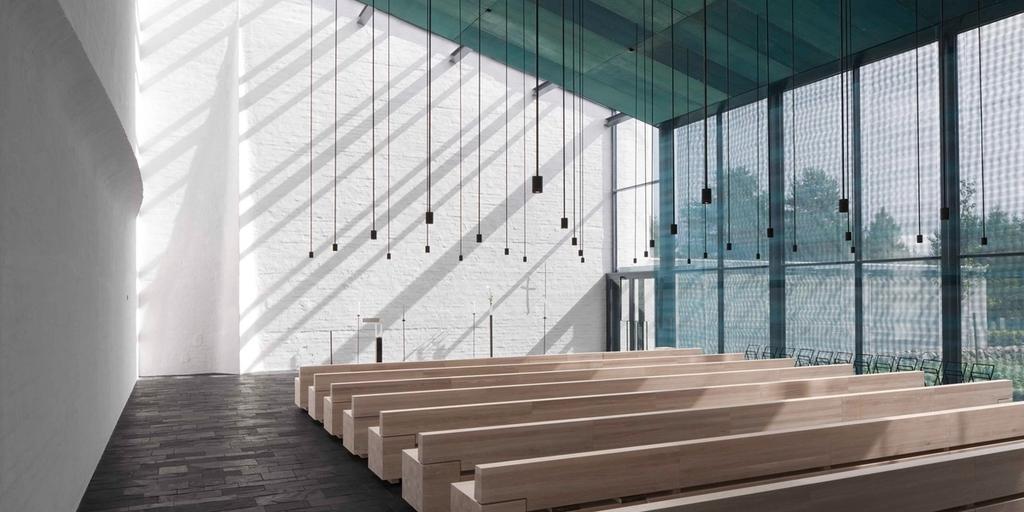
Riola Church in Vergato, 1978

Aalto also worked in religious architecture, and one of his most compelling projects is the parish church of Riola in Grizzana, Italy, near Bologna. The concrete building echoes the forms of the surrounding mountain landscape. The interior is distinguished by white asymmetrical ribs that cast a soft, diffuse shadow. Daylight enters through ribbon windows in the roof. The church interior is rendered in a modernist idiom: the nave is lined with wooden pews that decrease in height as they approach the altar.
Learn more about outstanding designers and architects of our time in our articles:
— Dieter Rams and his principles of design
— Le Corbusier — a pioneer of modern architecture
— Yohji Yamamoto — a philosopher in the world of fashion
— Zaha Hadid — one of the most celebrated women architects and a leading figure of Deconstructivism
Follow us on social media to stay up to date with new content: VKontakte, Telegram — @loskomagazine.