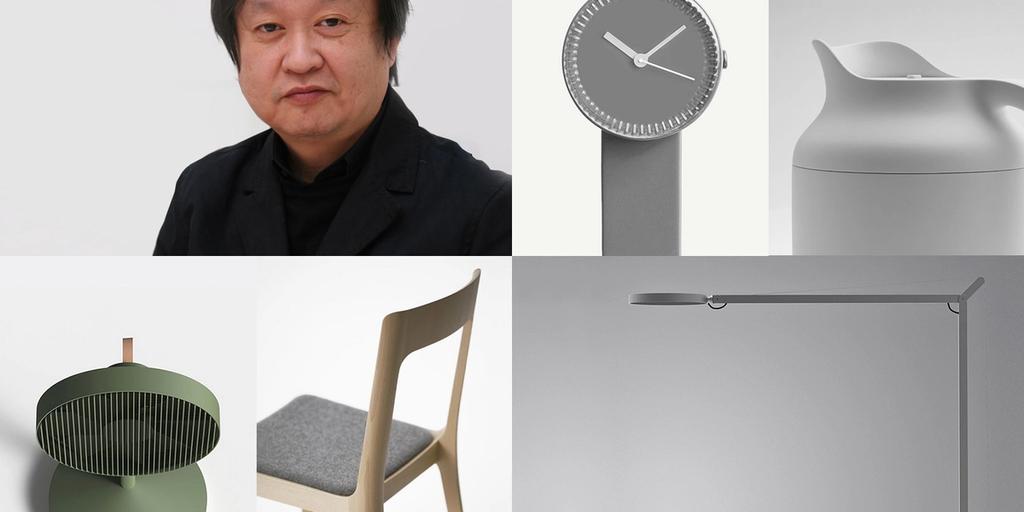
The minimalist industrial design of Naoto Fukasawa has been a source of inspiration for industry giants Apple, Hitachi and Toshiba. Naoto is a devotee of an ultra-austere way of living. In terms of his influence on contemporary design, Fukasawa is the equal of Dieter Rams. Why he remains little known in Russia is something of a mystery.
Naoto's projects are grounded in a rigorous aesthetic, ascetic forms, minimalist beauty, and the central tenet of Zen philosophy: true richness lies in what is utterly simple.
In this article you will:
- read a brief biography of Naoto
- discover 5 rules for creating and selling products
- explore Fukasawa's most celebrated projects
- find out why the designer keeps a mountain cabin with no electricity or running water

Biography
Naoto was born in 1956 in Yamanashi Prefecture, Japan. While still at school, Fukasawa was leafing through a book about professions and came across the definition of an industrial designer. He read: a designer makes people happy through objects. The definition appealed to Naoto, and the future designer resolved to devote his life to the profession.
In 1980, Naoto graduated from the Department of Art and Three-Dimensional Design at Tama Art University.
Fukasawa began his career designing watches for the Japanese diversified industrial giant Seiko. In 1989, Naoto moved to San Francisco, where he joined a small start-up called ID Two. Together with 15 colleagues, Naoto renamed it IDEO and transformed the company into the world's leading international industrial design agency.
In 1996, the designer returned to Tokyo, where he established an IDEO branch. Five years later he opened his first studio, Naoto Fukasawa Design. A year after that, he founded the brand ±0, which produces household goods. Around the same time, Fukasawa began working as art director for the technical division at MUJI.
Today Naoto simultaneously leads, oversees or advises four companies: IDEO, Naoto Fukasawa Design, ±0 and MUJI. In addition, he runs the creative workshop Without Thought, co-directs Japan's first design museum, and lectures at two Tokyo universities.
How to create, sell and take pride in your work: Fukasawa's 5 rules
Before starting work on a new product, Naoto retreats to his mountain cabin. The cabin has no electricity or running water, so the designer spends several days in an environment of deliberate austerity. During this time he asks himself whether a contemporary person truly needs the object he is about to work on. If he concludes that they do, he then considers how to simplify it as much as possible.
After returning from the cabin, Naoto begins developing the product, guided by five rules.
The Without Thought concept
If a person has to spend time working out how, say, a music player operates or how to unfold a sofa bed, that is bad design. Understanding how to use a product should be instinctive. Naoto called this idea Without Thought.
An object becomes intuitive when it performs a limited number of functions. For instance, Naoto argues against combining a printer, scanner and photocopier into one device — the interface becomes too complex. It is better to design them separately.
The core idea behind this principle is that objects should not demand attention, just as a pen does not distract a person while they are writing, or a glass while they are drinking.
Pictured: toaster and rice cooker for ±0
The tactile branding concept
People do not merely look at objects — they touch them. If a phone casing feels like aluminium but is actually plastic, that is a deception. Tactile experience must convey the true nature of an object.
Aware of how far-reaching this problem is, Fukasawa began travelling to conferences for designers and marketers, where he speaks about the idea of tactile branding.
The concept is perfectly illustrated by the juice packaging Naoto designed. There is nothing cheap or theatrical about it. Every last detail has been thought through: the strawberry juice carton has seeds on a glossy skin, the banana has dark spots, and the kiwi carton is covered in fine hairs.
If it is technology, it must be state of the art
When Naoto takes on a project — a mobile phone, for instance — the emphasis is always on high technology. Each time, he sets himself the same brief: the product description must include the word "most" at least once — thinnest, smallest, fastest. If a piece of technology cannot meet that standard, it will hold no interest for the modern consumer.
Fukasawa observes that technology is a service that makes life more comfortable, and that in the future it should recede from view so as not to distract us. The perfect example is found in certain smart-home features: lights that switch on automatically, temperature that adjusts according to the time of day, underfloor heating set to come on at a programmed hour.
Pictured: HF-1 lift for Hitachi
If it is furniture, it must last for generations
The designer's principal requirements of furniture are durability, simplicity and functionality. Naoto notes that design has recently become overloaded with personal expression, whereas Fukasawa's work distils the essential nature of objects themselves. He believes that through minimalism and high quality, a piece can serve several generations without ever growing tiresome.
Pictured: chairs for Plank and a bench for Linen
The Double Wow concept
"When I analyse the impressions of buyers after long use of objects, I feel proud of my projects"
Fukasawa urges designers to hold to his double-wow principle. The first wow should escape the buyer before they purchase the product. The second wow — which matters more to Fukasawa — is harder to achieve: it should come after the person has used and truly assessed the object.
Naoto adds: "When I analyse the impressions of buyers after long use of objects, I feel proud of my projects."
Pictured: bag for ±0
Naoto Fukasawa's 5 rules are grounded in a rethinking of Dieter Rams's design principles, to which he has added ideas drawn from Japanese Zen philosophy.
Fukasawa's notable projects
CD player for MUJI, 1999
The player takes its cue from a wall-mounted fan. It has no lid, so the disc spins in full view. The power cord also serves as the on/off switch: to start the player, you simply pull the cord.
Infobar phone concept, 2003
In 2003 the market was flooded with flip phones. Fukasawa wanted his handset to stand apart from the crowd, so he created a model shaped like a smooth stone. Naoto conceived the phone not merely as a communication device but as a defining mark of its owner's identity.
Since then, the designer has released four models of the Infobar.
X Shelving for B&B Italia, 2005
The bookshelf can be placed against a wall, mounted on one, or used as a room divider. It is also available in a range of shapes and sizes, making it a highly versatile piece.
Vertigo Set for B&B Italia, 2007
The collection of trays and bowls illustrates Naoto's core design principles: minimalism, compactness, distinctiveness — and, above all, a pleasing feel in the hand.
Papilio Chairs for B&B Italia, 2008

In creating the Papilio chair collection (papilio is Latin for butterfly), Naoto drew on the latest ergonomic research. He notes that sitting in a Papilio chair feels comfortable, calm and secure: a separate ottoman supports the legs, while the chair's 'wings' gently embrace the shoulders.
The collection is available in 20 colours. The material can also be chosen: leather or any fabric made to order.
The Hut, 2015
Naoto designed this wooden cabin as a retreat from urban noise and bustle. The only furnishings are an austere single bed, a table and chairs. The entire façade serves as both window and door: the transparent wall visually enlarges the compact interior and floods it with natural light.
More product photographs
Interesting facts
— Naoto admires designer Achille Castiglioni and artist Shiko Munakata, listens to jazz, reads traditional Japanese philosophy, and considers his CD player his proudest work.
— The designer does not wear ties and has a deep disdain for fashion design.
— Naoto has appeared in two documentary films: "Objectified" and "Genius Design".
— He has written three books: "Naoto Fukasawa", "Super Normal: Sensations of the Ordinary" and "Outline».
— Once a year, it brings together art directors and top designers from major competing companies. Over three days, they collaborate on a project that is subsequently realised. All the resulting objects can be seen at OZONE, the Japanese progressive design exhibition.
Learn more about outstanding designers and architects of our time in our articles:
— Dieter Rams and his design principles
— Le Corbusier — innovator in modern architecture
— Yohji Yamamoto — philosopher of the fashion world
— Zaha Hadid — one of the most celebrated women in architecture and a leading figure of deconstructivism
Follow us on social media so you never miss new content: VKontakte, Telegram — @loskomagazine.