Peter Lindbergh came to photography by chance, and went on to become one of the greatest fashion photographers of his era. For more than thirty years he shot for the world's leading glossy magazines. It was through his lens that the world first came to know Kate Moss, Naomi Campbell, Cindy Crawford and other legendary supermodels. He revolutionised the fashion industry by championing a woman's right to be herself in front of his camera.
In this article you will learn:
- about Peter Lindbergh's early years;
- about his work with Vogue and the supermodel phenomenon;
- about his work with Vogue Italia and his photo stories;
- about his shoots with actresses for the Pirelli Calendar;
- about the project 'The Covenant';
- about Peter's attitude to fashion and beauty;
- about how Lindbergh worked.

Peter Lindbergh: 'Beauty is the courage to be yourself.'
Childhood
Peter Brodbeck was born on 23 November 1944 in the Polish city of Leszno. Two months later, the war forced his family to flee the country: his parents, infant Peter, his brother and sister travelled 2,500 kilometres on a horse-drawn two-wheeled cart. They settled in Duisburg — a partially destroyed industrial city in western Germany on the banks of the Rhine. Peter's childhood unfolded among run-down factory buildings beneath a grey, smoke-stained sky. Although the photographer would later describe his hometown as ugly, its landscapes frequently returned to inspire him.
None of his family had any connection to the arts. His father worked as a confectionery salesman and his mother was a housewife who had dreamed of singing opera but could never pursue that dream amid the demands of domestic life. Photographs meant a great deal to Peter's family: there were almost no books in the house, and so every weekend the relatives would gather to look through old photo albums together.
Peter's earliest sources of inspiration were the paintings of Paul Gauguin and the family encyclopaedia. One day he came across a photograph of an African woman with a sagging breast and a child in her arms — that documentary image stayed with him for a long time.
From Brodbeck to Lindbergh: finding himself
The Academy of Arts, Van Gogh, life in Spain
At fourteen, Peter left school and took a job dressing windows at Karstadt. The display decorators captivated him: they seemed to him the most beautiful people in the city. They stood in the shop windows, arranging crockery, clothing and flowers, while passers-by stopped to stare.
When the time came for military service, Peter evaded it by going to Switzerland, but after nine months he returned to Germany and enrolled at the Academy of Fine Arts. He soon grew disillusioned with his studies: he wanted to make genuinely avant-garde art, but instead he was made to paint landscapes until he had mastered them. During that period Peter drew inspiration from Van Gogh, his singular vision, his fierce and furious creativity. Outraged by the prospect of painting landscapes for the rest of his life, he abandoned his studies and hitchhiked to Arles to understand how Van Gogh had become Van Gogh.
Peter's money ran out very quickly, and he decided to ask farms if he could stay in exchange for work. He was given board and lodging in return for his labour. During the day he worked, and in the evenings he painted — the results were poor, but he occasionally managed to sell a canvas in the main square in Arles. Peter was fortunate enough to live near the spot where Van Gogh had painted the Langlois Bridge: one of his own pictures even shows the roof of the house where he slept. It was a kind of creative pilgrimage — an attempt to draw inspiration from the same things that had inspired Vincent. But nothing came of it. Peter also discovered that the wind in Arles was so fierce that painting outdoors was practically impossible, as it simply scattered his paper. After eight months, he hitchhiked on to Spain.
Peter was drunk on freedom. Back home in Duisburg he had never seen exhibitions or read books, so during his years of drifting he absorbed everything like a sponge. He wandered the streets, visited museums, read and thought at length. He slept on beaches and occasionally smoked marijuana. It was during this same period that he read Aldous Huxley's essay on shifts in perception and tried LSD. In later life Lindbergh would return to that experience and compare it to the moment when a person looks out of a window and sees something extraordinary on the other side. For him it was a revelation — he even jotted down notes, among which he wrote: 'I am everything.'
Sultan, conceptual art, and the first photographs
After two years of wandering, observing and reflecting, Peter returned to Germany a changed man. He decided to study again, this time at an art school in Krefeld. It was the height of American conceptualism, which instantly seized Peter's imagination. He was struck by Joseph Kosuth's installation One and Three Chairs — by its powerful, distilled message.

That same year, in 1969, Peter met Hans Mayer, who offered him a show. Peter's debut consisted of 'monotypes' — square aluminium plates covered in black-and-white patterns, combined with one another in various ways. He signed his work under the pseudonym 'Sultan'. His first exhibition, held at the Galerie Denise René in Paris, was a resounding failure. It was then that Peter Brodbeck understood that conceptual art was too intellectual for him. 'Kosuth and Weiner destroyed my quiet life as an artist!' he would recall with laughter, reflecting on his aborted career.
Each time Peter tried to work out what to do next, he found himself turning to photography. His brother had had children and asked Peter to photograph them. Peter was delighted by the directness and honesty children showed in front of the camera: 'Small children are simply wonderful — they are open and give themselves entirely to the process. They haven't yet built a wall around themselves and have no idea how they want to appear to others.' Peter later came to understand that adults can no longer be so natural, because they observe themselves from the outside. This experience became the foundation of his distinctive approach to portraiture.
He came to photography professionally almost by chance: through a friend of a friend he heard that a commercial photographer in Düsseldorf, Hans Lux, was looking for an assistant. Peter was happy to take the job. He found photographing far easier than trying to keep pace with the rapidly evolving world of conceptual art.
'I could just as easily have been a baker or worked in a flower shop'
Hans Lux was not a brilliant photographer, and he never overshadowed his assistant. As a result, within a year and a half Peter had learned everything he needed and opened his own studio. Around the same time he changed his surname to Lindbergh: it turned out there was already a commercial photographer named Peter Brodbeck working in Düsseldorf. He was very fond of his new name, considering it both fortunate and in some ways defining. 'If I had taken the name Altbeck, who knows whether I would be sitting here today?' Lindbergh remarked in one interview.
The runway
The first glossy magazines to notice Peter's talent, back in the early 1980s, were the German publications Twen and Stern; commissions from Marie Claire and Vogue USA followed. Yet Lindbergh managed to make a truly dramatic impact on fashion photography only in 1990.
Stereotypes and American Vogue
The editors of American Vogue had approached Peter Lindbergh on several occasions, inviting him to shoot for them, but each time he declined. This caught the attention of Condé Nast creative director Alexander Liberman, who invited Peter to his office. When Lindbergh arrived, Liberman asked him why he had no interest in shooting for American Vogue. 'My editors tell me you don't want to work with us. Are you out of your mind? Do you have any idea what you're turning down?' Lindbergh answered honestly: he had no interest in photographing the image of womanhood that filled the pages of every major glossy at the time — the glamorous, wealthy woman with bold make-up and a crocodile-skin handbag. Liberman then offered him complete freedom to shoot whatever he wanted, however and wherever he chose.
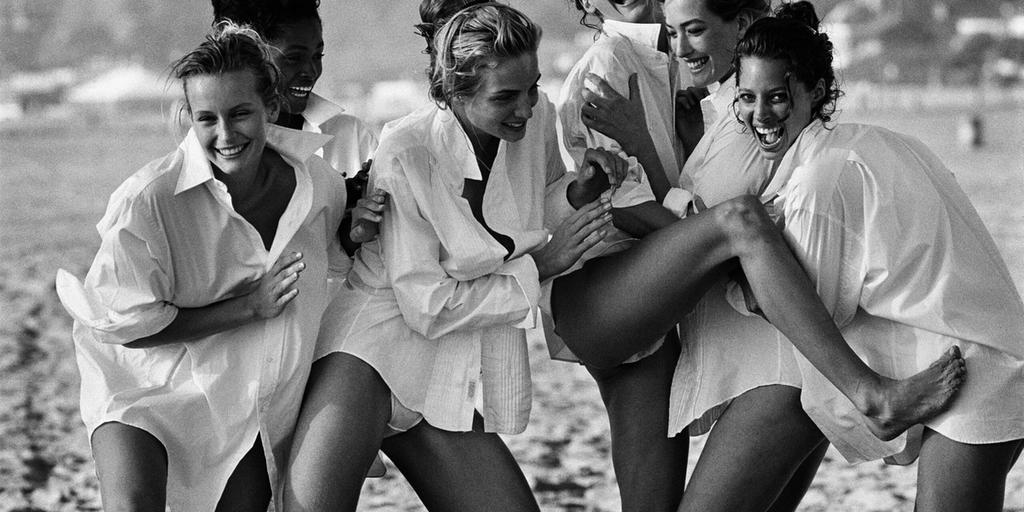
Peter selected several young and largely unknown models of the time. They drove out to the beach in Santa Monica, where Lindbergh made a simple, natural photograph. The girls wore plain white shirts; their hair was tousled, their make-up unadorned, and they played on the sand with a childlike spontaneity. Pleased with the work, Peter brought the image to Liberman's office. The editorial team failed to appreciate Lindbergh's innovation: after barely a glance at the photograph, they showed Peter the door.

Six months later, Anna Wintour took up the position of editor-in-chief of American Vogue — the woman who would later become the inspiration for the protagonist of The Devil Wears Prada. While sorting through the contents of the desk drawers in her new office, she came across those very photographs of the laughing girls in white shirts and immediately called Peter Lindbergh. 'This is the new modern woman,' Wintour told him. She gave Peter 20 pages and the freedom to decide who, how and where to shoot.
The cover of the following issue — the November 1988 Vogue — shocked even the magazine's own editorial team. Peter photographed Israeli model Michaela Bercu in a couture jacket paired with ordinary blue jeans. The original plan had called for a matching jacket-and-skirt ensemble, but the model had put on weight and the skirt no longer fit. The image felt unlike anything of its time — no glamour, a smile, eyes almost closed, hair dishevelled. Anna Wintour later said that she looked at the photograph and felt 'a wind of change'.
British Vogue and the dawn of the supermodel era
A year later, British Vogue editor-in-chief Liz Tilberis asked Lindbergh to shoot the January issue's cover in a way that captured, in his view, the 'spirit of the nineties'. Peter stayed true to his convictions: in the photograph, his favourite models gazed directly and boldly into the camera. Minimal tops and jeans, natural hair, no retouching, no heavy make-up — nothing that might draw attention away from the women themselves.

The women on the cover became stars overnight: after the issue appeared, George Michael invited them to appear in the video for 'Freedom! '90', and they were sought after at society parties and fashion shows alike. This image marked the beginning of the supermodel era — for the first time, the women in the photographs were not merely clothes hangers for designer fashion; they were now strong personalities with their own views and convictions.
Peter's love of the strong woman truly became the spirit of the age. Following that revolutionary cover, Lindbergh rose to become the most sought-after fashion photographer of his generation. For more than thirty years he shot for Vogue, Harper's Bazaar, Rolling Stone, Elle, Marie Claire and Vanity Fair.
Fashion shoots
Portraits
Peter Lindbergh worked regularly for major glossy magazines, shooting couture fashion campaigns. Editors gave him complete freedom: he chose the style of the shoot, the location, and — most importantly — the models himself. Lindbergh looked for intelligence, individuality, courage and a sense of humour in the women he photographed. His interest in such women went back to his youth. 'I liked the girls I met at art school. They wore tennis shoes and they had a purpose. They were independent and could speak for themselves.'
When Peter found interesting women to shoot, he would work with them for decades — they became his friends, and he followed their growth with genuine warmth and, at times, paternal tenderness. Some were very young when they first worked with him: Milla Jovovich was 15 when she began shooting with Peter, and Naomi Campbell was 18. In a very real sense, they grew up alongside Lindbergh.
Alongside models, Peter greatly enjoyed working with well-known actresses. Such shoots had their own particular quality: although actresses were accustomed to having a camera nearby, looking directly into the lens while remaining entirely themselves was still no simple task.
And although the photographer worked within the fashion world, the industry itself held little interest for him — at times he did not even know which clothing brand he was shooting for.
Peter Lindbergh's overriding aim was to free women from imposed standards of beauty. He campaigned consistently against the retouching of photographs and, in time, included a clause in his contracts prohibiting any alteration of his images — without it, magazines would automatically retouch a shot, erasing everything that fell outside their idea of what was 'beautiful'.
Lindbergh most often worked in black and white — he believed that colour distracted from the face. He arrived at this conviction in his youth, studying the documentary photographs made by American photographers during the Great Depression. But black-and-white film, the absence of retouching and an interesting woman were not, in themselves, enough to make a great portrait. The most important thing was to build a warm, trusting relationship with the person standing in front of the camera.
'Photography is not one person documenting another person. It is a photograph of the relationship you had at the moment of the shoot.'
A commitment to naturalness ran through every aspect of Peter Lindbergh's work. Before each shoot he would sit down and write out how and what he intended to photograph — but he did so only so that he could 'sleep at night'. As a rule, the process would unfold in ways entirely contrary to plan, and the hardest thing was to let go of the original idea. In his work, Lindbergh made a point of remaining open to the unexpected, and was never afraid to take a wrong turn.
Story shoots
Alongside his black-and-white emotional portraits, Peter Lindbergh produced series of photographs unified by a single narrative. He called these 'stories'. He most often made them for Italian Vogue, whose editor-in-chief was Franca Sozzani, a colleague he had known since the 1980s. She would give him up to 45 pages per issue, which Peter could fill however he wished.
Through such shoots, Peter gave full expression to his talent for storytelling and cinematic imagery. He created fantastical narratives — in which people encountered aliens and angels roamed the streets of New York — alongside intimate domestic ones, exploring family dramas or the difficult lives of two sisters left without parents. These photographs felt less like fashion images than stills from a film.
To realise his ideas, Lindbergh had to hire extras and negotiate with Franca Sozzani for larger budgets. On one occasion, for a story about a lonely alien, Peter was eight thousand dollars short. It was an extraordinary sum, and Sozzani flatly refused him.
"I remember exactly what she said: 'Go to hell, Peter! We don't need aliens in Vogue.' But you know who got their way in the end."
The photographer drew inspiration for his stories from simple observations of everyday life, from films, or from chance discoveries entirely: that very first photo story about an alien came about because someone had left images of UFOs and extraterrestrials in a dentist's waiting room. Lindbergh returned to the theme on numerous occasions, each time approaching it from a different angle.
The Pirelli Calendar
The legendary Pirelli Calendar has, since 1964, continued to enlist the finest photographers and models for each edition. Produced in a limited print run, it holds a special place in the world of photography. The shoots most often feature partially nude models. Peter Lindbergh is the only photographer to have worked on the calendar three times, and on every occasion his images challenged the prevailing status of women.
His third and final calendar, created for 2017, once again overturned a world in which beauty is invariably equated with youth. For this edition, Peter Lindbergh photographed 14 actresses of varying ages, as ever dispensing with retouching and heavy make-up. Steadfast in his convictions, he championed a woman's right to be imperfect, to have wrinkles, and to remain beautiful nonetheless.
"It should be the duty of photographers today to free women, and finally everyone, from the terror of youth and perfection."
Alongside the actresses, the calendar also featured Anastasia Ignatova, a lecturer at MGIMO, whom Peter had met in 2016 and promised to photograph if he was ever asked to shoot the calendar again.
The Testament Project
In 2013, Peter Lindbergh embarked on a personal project he called Testament. For it, Peter reviewed several dozen prison inmates' case files and wrote to them with proposals for a shoot. The aim of the project was to capture an unbiased portrait of a person. Four convicts agreed to take part, but only one of them was genuinely open in front of the camera — Elmer Carroll.
At the time, he had been serving a 21-year sentence for the rape and murder of a 10-year-old girl. Peter and his team arrived at the prison and positioned the camera at Elmer's eye level, with a mirror placed between him and the lens. The prisoner was silent; his hands and feet were shackled. Elmer's face was deathly pale and covered in red blotches.
The convict was required to look silently into the camera for half an hour. After that, the lights and camera were switched off, and Elmer Carroll was given 4 minutes to say whatever he wished. Lindbergh promised to pass all the material to Elmer's daughter, whom he had last seen when she was 3 years old. During the shoot, Peter and his team remained behind the mirror. Elmer Carroll was executed two months after filming. The 30-minute Testament was screened in museums in curtained rooms.
Lindbergh's Philosophy
As in his youth, when Peter wandered the streets of Spain without a penny to his name, he drew inspiration from the real world. Lindbergh was critical of contemporary photographers who sit in their offices, flick through glossy magazines and decide to make something similar. He regarded such work not as creativity but as blind imitation, devoid of originality. True creativity, Peter believed, must always come from within.
Another key element of Lindbergh's philosophy was the notion of 'self-identity' — honesty with the world around you and with yourself. Peter practised meditation for more than 25 years in order to learn to accept himself and the world he lived in. This practice was partly responsible for the naturalness of the people in his photographs: he allowed them simply to be themselves.
Creativity is a reservoir inside you, and it must be filled with everything you feel, see and think. That is the raw material you need in order to create.
How Lindbergh worked
- Preferred film-based Nikon 35 mm
- Avoided retouching — at most, removing a blemish
- Shot with a slightly soft focus
- Loved people and let them be themselves
- Did not strive for a perfect composition
- Responded to the moment: if things weren't going to plan, he would abandon the plan.
Interesting facts
- Lindbergh met his wife Petra in Goa, where she was working as a chef at a hotel
- Forty-eight years after his first visit to Arles, Lindbergh bought a house there
- Linda Evangelista was for a time married to Peter's best friend
- At eighteen, Peter played drums in an obscure jazz band. Near the place where they rehearsed there was a cemetery, and the young musicians would sometimes help their neighbours with funerals
- The first film Lindbergh ever saw — and the most inspiring — was Fritz Lang's Metropolis
- Other works by Peter Lindbergh
If all these black-and-white photographs have left you craving colour, we invite you to read the biography of Saul Leiter — pioneer of colour photography. We also recommend the biographies of other photographers on our site:
— Annie Leibovitz. A Life Through the Lens
— Henri Cartier-Bresson — a legend of street photography
— Vivian Maier: the most enigmatic photographer of the twentieth century .
Also follow us on social media so you never miss new content: VKontakte, Telegram — @loskomagazine.