For several years now, the Garage museum has been hosting art lectures by Irina Kulik titled "Asymmetrical Resemblances". Kulik is an art historian, art critic, educator, and translator into Russian of works by philosophers and figures from the art world — among them Michel Foucault and Marcel Duchamp. In each lecture in the series she discusses two artists whose practices echo or contrast with one another in some way. Losko features profiles of several of them.
Georgia O'Keeffe — Robert Mapplethorpe

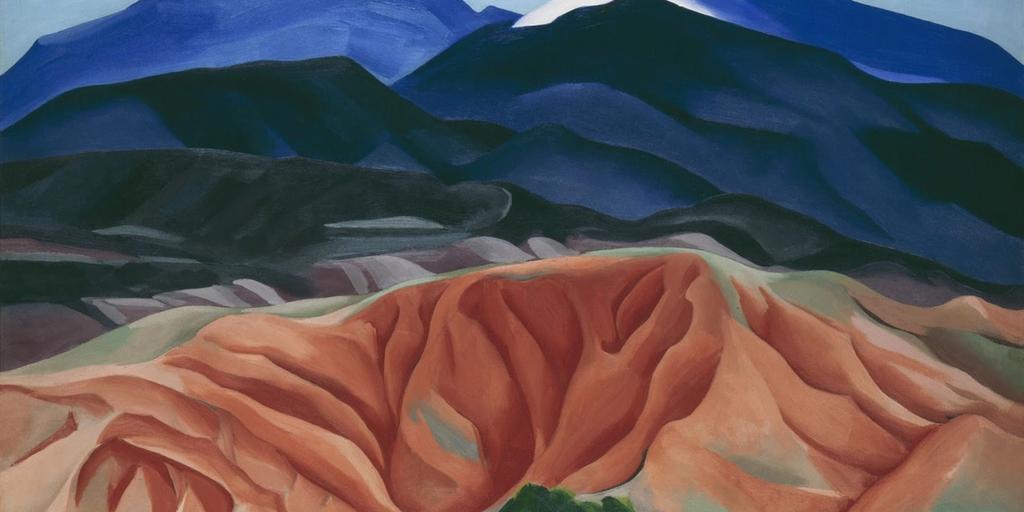
Georgia O'Keeffe was born in 1887 and is widely regarded as the first American modernist. She also became the first woman artist to be honoured with a solo retrospective at the Museum of Modern Art in New York, in 1946. O'Keeffe is best known for her paintings of flowers, but her primary source of inspiration was music, which she rendered on canvas in the form of abstractions.
Robert Mapplethorpe was an artist of the second half of the twentieth century. His work consists predominantly of studio-based, often erotic portraits of Black people, homosexuals, and members of other social minorities — subjects who, in the 1960s through the 1980s, were regarded as deeply marginal.
Watch on Youtube
Frida Kahlo — Ana Mendieta

Frida Kahlo is one of the world's most celebrated artists and needs no introduction. Following a devastating accident, she began to paint — depicting herself above all else. Kahlo's works convey, with sincerity, directness and expressiveness, the full turbulence of feelings that ran through her rich and difficult life. Her style can be placed within the traditions of naïve art or Surrealism, and her paintings frequently contain references to Mexican culture.
Ana Mendieta was an American artist who emigrated to the United States as a child following the Cuban Revolution. Mendieta is known for her feminist performances. Questions of identity, gender and sexuality are central to her work. As with Frida Kahlo, a deep engagement with her national culture runs throughout her practice.
Watch on Youtube
Andy Goldsworthy — Banksy

Andy Goldsworthy is a Scottish land artist and photographer who creates sculptures around the world, including at the North Pole. His works are made from natural materials such as leaves and branches, without the use of any tools. Goldsworthy's sculptures are not always long-lasting, so he photographs them immediately after they are made. Through his art he explores the relationship between art and nature. He is also credited as the originator of contemporary stone balancing.
Banksy is one of the most influential and celebrated street artists of our time. He rose to prominence through graffiti works in which he addresses political and social themes. Banksy's pieces are so sought-after that some have been physically removed along with chunks of wall in order to be sold for enormous sums.
Watch on Youtube
Jackson Pollock — Yves Klein

Jackson Pollock is known for paintings created through the technique of dripping and splattering paint. The expressiveness and physical movement of the artist at work are also regarded by some as an integral part of his art. Pollock did not consider the resulting paintings to be products of chance: he envisioned a specific outcome and sought to realise it on the canvas. His work was influenced by the Mexican artists Diego Rivera and José Clemente Orozco, as well as by the ritual practices of the Navajo people, who created paintings from sand.
Yves Klein was a French avant-garde artist. He was a member of the Rosicrucian order, held a variety of occupations throughout his life, and taught judo. While in Japan he wrote a book on the martial art and earned a black belt. Klein came to art at the age of 26, eight years before his death. Some of his paintings were made using the bodies of models as brushes, and from 1956 onwards a deep, saturated blue began to dominate his work. That blue is a synthetic ultramarine. Yves Klein started using it in 1956 and patented it under the name IKB — International Klein Blue.
Watch on Youtube: part 1 and part 2.
Yoko Ono — Ai Weiwei

Yoko Ono is a celebrated Japanese avant-garde artist, musician and cultural figure. She also made experimental films and became one of the first artists whose work requires the active participation of the viewer. Yoko Ono is considered one of the founders of conceptual art. After marrying John Lennon, she set aside her art career in favour of political performance, but returned to art following the musician's death.
Ai Weiwei is a Chinese artist, architect, curator, critic and dissident. He spent several years in New York, where he studied at a design school, before eventually returning to China. The artist is a sharp critic of the Chinese Communist Party, and politics forms an essential part of his practice. Ai Weiwei conducted his own investigation into the circumstances of the 2008 Sichuan earthquake and published his findings; in 2011, while attempting to leave China, he was arrested and held for several months.
Watch on Youtube
Edward Hopper — Giorgio de Chirico

Edward Hopper is one of the most brilliant figures in twentieth-century American painting. His work brings together the style and ideas of the Impressionists and the Realists. Hopper sought to depict reality as it is, yet conveyed it through emotion — through colour and line. He has been called a "poet of empty spaces", an urbanist, and a forerunner of Pop Art. His paintings are indeed an ode to the city, in which the clean lines of architectural detail become the central protagonist.
Giorgio de Chirico might equally be described as an urban artist. He frequently depicted architecture, but rendered it cold and detached, in the manner of Renaissance painting. De Chirico was also close to the Surrealists, and his painting The Song of Love made a deep impression on another celebrated artist, René Magritte, opening up an entirely new direction in his work.
Watch on Youtube: part 1 and part 2
René Magritte — Christo

René Magritte is best known to general audiences for two works: The Treachery of Images and The Lovers. Magritte was a nonconformist who could not find common ground even with his fellow Surrealists. He approached the making of each work with mathematical precision. Every painting is a riddle whose answer the viewer must discover for themselves.
Christo Javacheff was a sculptor who created his works from fabric. He began by wrapping small objects — a typewriter, for instance — before moving on to ever larger ones. In 1995, for example, Javacheff wrapped the entire Reichstag building in cloth. What defined Christo's work was that, after years of preparation by the artist, each piece existed for only a matter of days before disappearing. This freed Christo from the need to own or sell his creations.
Watch on Youtube.
Andreas Gursky — Jeff Wall

Andreas Gursky is the world's highest-paid photographer: his photograph Rhine II sold at auction for a record $4.3 million. His works are distinguished by their monumental scale, panoramic sweep, extraordinary density of detail, and a detached gaze upon the subject. To achieve this effect, he composites multiple viewpoints into a single unified image. The most frequent subjects in Gursky's photographs are nature, crowds of people, and urban infrastructure.
Jeff Wall is a Canadian photographer and photography theorist, and a representative of the Vancouver School. Like Gursky, he works at large scale, makes extensive use of montage, and displays his photographs in lightboxes at exhibitions. Wall shoots landscapes and everyday scenes, the latter often staged with the help of actors and assistants. Jeff Wall is the recipient of one of the most prestigious awards in photography, the Hasselblad Award.
Watch on Youtube
Joseph Beuys — Andy Warhol

Joseph Beuys was a German artist and theorist of postmodernism. His early watercolour drawings evoke cave paintings and are dominated by various animals. Later, Beuys turned to performance art. The defining motif of his work, however, became his use of unconventional materials for art objects — rendered fat, felt, and wool felt — a practice he explained through a mythical incident he claimed to have experienced in 1943 during his military service.
Andy Warhol was a pop art artist, as well as a writer, filmmaker, photographer, and magazine publisher. He is known for his paintings of Marilyn Monroe and Campbell's tomato soup cans. In 1963, Warhol opened his famous studio, which he called the Factory, where he put silkscreen painting into mass production. The studio became a favourite haunt of New York's bohemian crowd.
Watch on Youtube.
Paul Klee — Jean-Michel Basquiat

Paul Klee was a German avant-garde artist, graphic artist, and art theorist of the early twentieth century, and a member of the celebrated group Der Blaue Reiter. He was a close friend of Wassily Kandinsky and a teacher at the renowned Bauhaus school. The house where Klee was born now hosts a school bearing his name, while in Bern there is an exhibition centre named in his honour and designed by the architect Renzo Piano.
Jean-Michel Basquiat first came to prominence as a graffiti artist in New York's SoHo neighbourhood, and later began painting in the neo-expressionist style. Critics frequently compared Basquiat to Paul Klee and other German expressionists. Basquiat lived only twenty-seven years and died of a drug overdose, yet in that time he built a remarkable career as an artist. In the final years of his life he was close friends with Andy Warhol, with whom he produced many collaborative works.
Watch on Youtube: part 1 and part 2.
Follow us on social media so you never miss new content: VKontakte, Telegram — @loskomagazine.