Henri Rousseau was a self-taught French painter and dreamer who did not take up painting seriously until the age of 40. Without any formal training or connections, he managed to capture the attention of the Parisian avant-garde and earn his place alongside such celebrated artists as Pablo Picasso, Henri Matisse and Paul Gauguin, becoming a pivotal figure in the history of naïve art.
Regarded with suspicion and mockery by some, and hailed as a genius of primitivism by others, Rousseau continues to divide art historians to this day, while his imagined jungles astonish with their primal grandeur.
In this article you will learn:
- how a lack of professional skill and childlike innocence became Rousseau's signature style and led him to success;
- why Henri Rousseau was known throughout his life as 'the Customs Officer';
- what other figures in the art world thought of his work;
- what primitivism and naïve art are;
- fascinating facts about Henri Rousseau's life and work.

Early Years
Henri Julien Félix Rousseau was born on 21 May 1844 in the small French town of Laval. His father was a tinsmith by trade, and his mother was the daughter of an officer in Napoleon's Grande Armée. The family was never particularly well off. By the time Henri turned 8, his parents had gone completely bankrupt and lost their home, and young Rousseau was sent to a boarding school. It was there that he discovered his love of drawing. Henri Rousseau also showed considerable promise in music and even won several school prizes.
Having finished school in 1861, the 17-year-old Henri moved with his family to Angers, where he found work as a bailiff's assistant at a law office. His career was short-lived, however, due to a scandalous incident. In 1863 Rousseau was accused of petty theft and, to avoid a prison sentence, agreed to seven years of military service. He encountered soldiers who had served in the French expedition to Mexico (1862–1865) in support of Emperor Maximilian I. Rousseau eagerly listened to their accounts of that subtropical country and was captivated by them. In time, those stories would exert a profound influence on his depictions of the jungle, and the vividness of his colours and the lifelike quality of his paintings gave rise to rumours that the artist was painting fragments of his own memories of those places. Notably, Rousseau himself never left France, though he never denied the popular legends about his travels.
Henri 'the Customs Officer' Rousseau
Immediately after his service, Henri Rousseau moved to Paris to care for his mother following his father's death in 1868. His term of service had been cut short by two years, as he had become the family's sole breadwinner. Having rented lodgings near Le Bon Marché, the artist fell in love with the landlady's daughter, Clémence Boitard, and married her a year later. On weekends the couple would stroll through the parks of Paris, and Rousseau often painted portraits of his wife. Henri Rousseau was not only a painter but also a musician: he composed a waltz for Clémence and named it in her honour.
In Paris, Rousseau took a position as a bailiff's clerk. The work did not suit him: he was regularly required to call on destitute people and seize their belongings. This stirred unpleasant memories of how his own family's home had similarly been put up for auction because of his father's debts. After three years as a bailiff's clerk, at the age of 27, he decided to take a post with the Paris Customs Service of the Excise Department. In his spare time Rousseau threw himself into painting. On occasion this happened at work itself: he would set up his easel and paint for hours. During his time with the customs service, Rousseau produced a great many canvases, which are also known as his 'customs landscapes'.

'I always see the painting before I paint it,' — Henri Rousseau
Clémence suffered from tuberculosis for a long time and died in 1888. Of Rousseau's nine children, seven died of tuberculosis in infancy. Only his daughter Julie-Clémence and son Henri-Anatole survived. They were raised by a nanny in the outskirts of Paris, as Clémence's poor health prevented her from caring for them herself.
Rousseau later married again. After moving with his son to Montparnasse, Henri met Joséphine Letensorier, who lived nearby. Following her husband's death, Joséphine repeatedly turned Rousseau down, but eventually agreed to marry him, and in 1898 they wed. Their life together was brief: Joséphine died in 1903.
In time, when the 49-year-old Henri decided to leave his job at the customs office and devote himself entirely to his art, he met the writer Alfred Jarry. It was Jarry who gave Rousseau the nickname 'Le Douanier' — the Customs Officer — a sobriquet that stayed with him for the rest of his life, despite his considerable achievements as a painter. In itself the nickname was harmless enough, yet those around him used it mockingly, as if to make plain, once again, that they did not regard him as a serious artist.
Rousseau honed his artistic skills by copying paintings in the galleries of Paris and sketching in the city's botanical gardens and history museums. Because he had received no formal art training and had absorbed none of the academic dogmas, he was able to develop a style entirely his own. Having never studied anatomy or perspective, his portraits and landscapes had a childlike, naïve quality. With the same naivety, he took the sarcasm and teasing of those around him for sincere praise. The defining characteristic of his work was a dramatic intensity and vivid abundance of colour; distorted spaces and unrealistic scale appear in his paintings with striking regularity.
Salon exhibitions
In 1886, at the age of 42, Rousseau submitted his first application to the Salon des Indépendants — an exhibition open to any artist who wished to show their work. Henri presented the painting A Carnival Evening, which depicts a young couple in carnival costumes walking across a field on a winter's night.

Despite Rousseau's unshakeable belief in his own success, an unprepared public greeted the artist's debut with contempt and ridicule, criticising him for his peculiarly 'childlike' manner and accusing him of poor perspective and composition. 'My five-year-old could have done as well' became an increasingly familiar refrain from the crowd. Yet, for all the hostility of ordinary Parisians and the city's bohemian set, Rousseau's work did strike a chord with certain Impressionists. Camille Pissarro, for instance, noted the distinctive tones in A Carnival Evening and their power to express the relationship between light and shadow.
'If you remove the lines from a drawing, the colours will no longer mean anything,' — Henri Rousseau
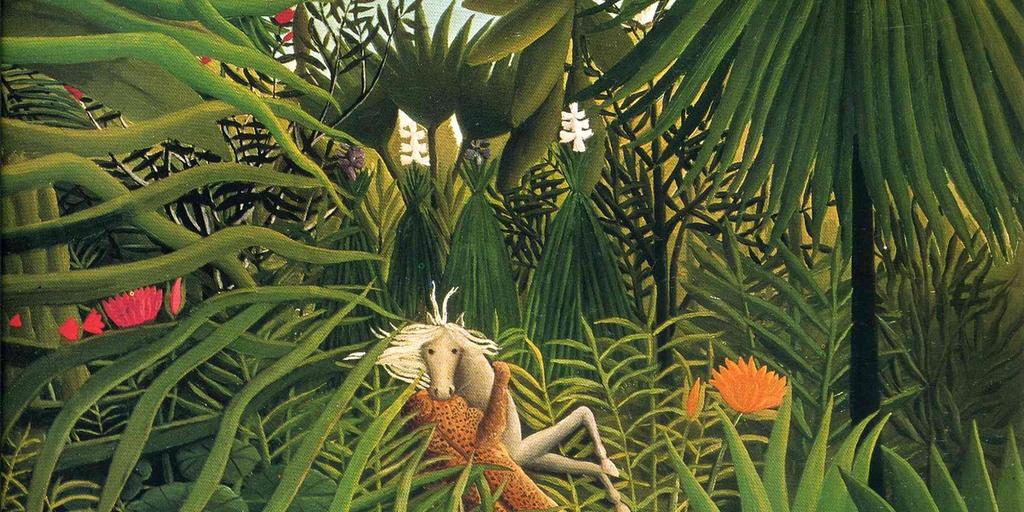
Nearly twenty years later, the artist — then 61 years old — decided to take part in the Salon des Indépendants once more. He presented the painting The Hungry Lion Throws Itself on the Antelope, which marked the beginning of an entire series of works sharing a similar theme and approach: vivid and menacing jungle scenery, a blue sky and a sun stripped of light and shadow, and at the centre a predator pinning its prey to the ground. The painting undoubtedly reflected the development Rousseau had undergone over two decades, yet his technique remained as unpolished as ever — something the public evidently found difficult to overlook.

Primitivism and the influence of folk art on the artist
Henri Rousseau has gone down in history as one of the most celebrated exponents of primitive art. Primitivism, or naïve art, is a current in painting and sculpture that draws on the imagery and objects of ancient cultures. The term 'primitivist' was often applied to trained artists who deliberately turned away from academic convention in pursuit of a new and more sincere form of expression. It also describes artists who had no formal training in painting whatsoever — a lack of technical grounding offset by natural talent. The essential distinction between the two lies in the fact that for self-taught artists this style was organic and authentic, whereas educated painters consciously strove to arrive at naïve art.
Henri Rousseau would write explanatory poems of his own composition to accompany his works. These were frequently referred to as 'Rousseau's painted poems'. They connect his practice to the tradition of French folk art: much as the inscriptions found on peasant works added meaning to the image, Henri's words lent an additional layer of significance to the content of his paintings.
One example of such a commentary is the poem written for The Sleeping Gypsy: A wandering gypsy playing the mandolin, her pitcher set beside her, sleeps a deep sleep beneath the poetic light of the moon. A lion happens to pass by, sniffs at her, and does her no harm.Rousseau considered The Sleeping Gypsy one of his finest works and offered to sell it to the mayor of his hometown of Laval for 2,000 francs — a considerable sum at the time.
Henri first encountered folk art in childhood. The walls of the family home were hung with portraits of his father and mother — typical examples of peasant craftsmanship. Yet an even greater influence on Rousseau was in all likelihood the Épinal prints that had become popular among the residents of Laval in the early and mid-nineteenth century.
Rousseau's Jungles
Rousseau's jungle scenes are often described as a botanical Eden. His lotus-like flowers and extraordinary variety of foliage appear at once remarkably vivid and strangely abstract. Henri was drawn to the practice of working from photographs; he was particularly fond of their plastically defined volumes, and the unnaturalness of their poses and facial expressions. These qualities, he believed, introduced a sense of the eternal into everyday scenes. His paintings frequently appear to merge viewpoints from several different vantage points simultaneously. He renders plants as large, majestic and yet flat. Regardless of what inhabits his jungles — whether a lion is bringing down an antelope or a gorilla is attacking an Indian — in Rousseau's paintings the jungle always appears calm.
When I step into the greenhouses and see the plants from exotic countries, I feel as though I am dreaming,— Henri Rousseau
Rousseau had a singular and highly individual vision of nature, but he drew inspiration from more than his imagination alone. To paint animals with greater accuracy, for instance, he spent long hours in the zoological gardens and natural history collections of Paris. One of his key inspirations wasEugène Delacroix, celebrated for his paintings of lions and tigers.
His imagination transformed the undergrowth of any stream into palm trees, the fruits of the hop into the tuber of an exotic vine. Oranges hung in the jungle like orange balloons, and tiny flowers had grown a hundred times their natural size. He seems to have genuinely seen monkeys hanging from the branches,— Natalia Brodskaya, art historian


Rousseau in the Public Eye
His friendship with Alfred Jarry gave Rousseau an entrée into the literary and artistic avant-garde of Paris, including Pablo Picasso and Max Jacob, who would go on to become genuine admirers of his work. Rousseau was something of a hero to Picasso, who was convinced that it was precisely Henri's naivety that allowed him to lay bare the essence of humanity and move beyond the conventional representation of nature.
Sadly, Henri Rousseau's persistence and artistic vision never managed to win the public over. He was a figure of ridicule wherever he went; people refused to accept him or acknowledge him as an artist and a master of primitivism. Yet this did not trouble Rousseau in the least — he had a remarkably easy-going nature and more often than not simply let the negativity wash over him. At some point he even found his way into bohemian society: Henri hosted 'evenings at the Customs Officer's', at which he showed young people his paintings and entertained guests with music.
"Rousseau leads an utterly naïve way of life," — Picasso "He would blush easily when someone contradicted him or when he felt awkward. He agreed with everything that was said to him, yet one sensed that he kept his distance and simply did not dare to speak his mind," — Fernande Olivier, Picasso's companion
Van Gogh attended one such evening and decided to introduce himself to Rousseau in private: "Take off your mask, Rousseau. You must understand — I too am a peasant and an artist."
In the end, Rousseau did have his moment of glory, thanks to the efforts of Picasso and his companion Fernande Olivier, who decided to organise a banquet in the artist's honour. In preparation for the event, Picasso cleared one entire wall of his studio, temporarily removing his collection of African masks, and hung Rousseau's Portrait of a Woman in their place.

Among other touches, the friends placed a throne at the head of the table for the guest of honour. All of this came as a complete surprise to Rousseau. He was equally unprepared to find thirty invited guests drawn from fashionable Parisian society waiting to greet him with thunderous applause. The evening went down in history as the "Famous Banquet at Picasso's".
Conclusion
Henri Rousseau died on 2 September 1910 from complications of gangrene. Even after his death, his work continued to inspire other artists, among them Pablo Picasso, Fernand Léger, Max Ernst and many of the Surrealists.
"Nothing makes me happier than contemplating nature and painting it. You will believe me when I say that when I go out into the countryside and see the sun, the greenery and the flowers, I sometimes say to myself: 'All of this belongs to me — it truly does!'" — Henri Rousseau
Rousseau's paintings are distributed across museum collections around the world. Two of his most celebrated works — The Sleeping Gypsy and The Dream — are held at the Museum of Modern Art in New York, while others belong to the National Gallery of Art in Washington, D.C., the Philadelphia Museum of Art, the Hermitage in St. Petersburg, and many more.


Other works by the artist
Interesting facts
- Henri Rousseau was a member of the Masonic order.
- Rousseau was not only one of the first primitivists but also the originator of the 'portrait-landscape' genre.
- The artist frequently wrote autobiographies, referring to himself in the third person: "As a distinguishing feature he wears a square-cut beard and has been a participant in the Salon des Indépendants for a number of years, believing that absolute freedom of artistic expression will reward the bold…" — from the Autobiography of Henri Rousseau.
- In 1907, wishing to help a friend, Rousseau forged a cheque. He managed to avoid imprisonment, though how he did so remains unknown to this day. According to one version, the judge was disarmed by the artist's extraordinary naivety; according to another, a senior official who was a member of the French Masonic order arranged for his release.
- Although Rousseau was known among his contemporaries, painting brought him almost no income. Fame and recognition came to Rousseau only after his death.
Read also our other artist biographies: Van Gogh, David Hockney, Georgia O'Keeffe, Wassily Kandinsky, René Magritte, Frida Kahlo, Edward Hopper.
Follow us on social media so you never miss a new story: Telegram.